Sunday, April 29, 2007

Bobby "Boris" Pickett MONSTER SLASH


Bobby "Boris" Pickett had a good sense of humor...he'd tour monster conventions and do oldies shows offering "a medley of my hit." Despite many novelty attempts (including a Christmas single "Monster's Holiday" that also failed via a Lon Chaney Jr. cover version, and "Monster Motion," his attempt at a Bela Lugosi horror-dance hit) he never did rise beyond the status of "one hit wonder."
BUT...that one hit actually hit the charts three times, and will continue to be played every Halloween.
It might even be a hit again, although he won't know about it. He died of leukemia a few days ago, April 25th.
Even his obit was sort of a gag-line: "Bobby Boris Pickett Dies at 69." Yeah, it sucks. Well, rather than offer you any of the Pickett songs you probably know, or ones you're better off not knowing ("Monster Rap" for example), here's one of his last recordings, the environ-mental "Monster Slash." Mindful of his daughter and grandchildren's future, Bobby lent his support to an ecology group raising awareness of George Bush's policies on ecology:
"We were hiking in the forest late one night. When our eyes beheld an eerie sight. Our president appeared and began to frown. Then he and his friends cut the forest down...They did the Slash! They did the FOREST SLASH. It was brutally brash. Public opinion was mashed. And they did it for the cash..."

MONSTER SLASH Instant Download or Listen on Line

"KITTY CARLISLE" (NOT "PUSSY C*NT")


I'll get to the rude parenthesis in a minute. First, some nostalgia.
The first celebrity I ever met was Kitty Carlisle. I was in a museum with my parents and they pointed her out. No, she wasn't on display at the museum, though she was picture perfect. I guess my folks figured it would be a "learning experience" to meet a celeb and not be shy. So Dad found a pen, Mom had a crumpled bit of blank paper in her purse, and off this grade-schooler went. "Excuse me, Miss Carlisle..."
She couldn't have been more graceful or kind. She ultimately turned me around, put the paper against my back (no furniture) and signed her name. I still have that piece of paper, and a fondness for this woman who was the epitome of class, manners and good taste. Things, obviously, that remain elusive for me.
You'll hear Kitty singing on the download below. Yes, she really was a singer. That's her singing voice in "A Night at the Opera," and she appeared on stage in many operettas. While she would attain an odd star status as a quiz show personality via "To Tell the Truth," and as the wife of Broadway legend Moss Hart, Kitty was a legit singing star, and she performed at Feinstein's and on tour till she was 95. She died at the age of 96 last week, still looking at least 20 or 30 years younger.
Oh yes, the Pussy Cunt remark. Well, that's pretty much what "Kitty Conn" meant to the French. When she went off to Paris to complete her education, her real name, Kitty (short for Katherine) Conn, caused problems: "My last name was Conn, and in Paris, it was an embarrassment, because it sounded like a very naughty French word, so I couldn't wait to change it."
Only over the past decades has "con" changed to mean not only cunt but fool or asshole. Across the channel, "cunt" in England can also mean an idiot more than a part of the anatomy. In fact, a "cunt" could be a jerk who's a prick.
To bring this tribute to Kitty Carlisle out of the gutter, here's a lovely song by the lady herself, "Now," from "Song of Norway." I actually saw the show in a revival, and it was more like "Song of Bore-way," and the audience needed the revival of drinks at intermission. However, "Now" as originally done by Kitty, still has charm and a good message: "Yesterday's dead. Tomorrow you'll be older...all that matters is now."
Kitty Carlisle sings... NOW!

Thursday, April 19, 2007

WATER ON THE MOON Prof. Liviu Librescu


The reports said that the 23 year-old kid was armed with a Glock and a Walther .22-caliber; two guns and enough ammunition to fire 30 rounds without having to re-load. When he came to the classroom door, he was met by 76 year-old Professor Liviu Librescu.
He "blocked the doorway with his body and asked the students to flee. Students started opening windows and jumping out." Professor Librescu, a Holocaust survivor, did not survive the Virginia Tech massacre.
He was the head of the Engineering Science and Mechanics Department. He was born in Romania, found his way to Israel, and ultimately made his home in America.
Anyone grieving over the death of a loved one would benefit from owning the concept album about love and loss entitled "Somewhere Between Heaven and Earth." It's by Cindy Bullens, and on this track Rodney Crowell is on harmony vocals.
Prof. Librescu was a man of science, so I chose "Water on the Moon." Cindy was inspired by the news of this discovery to ponder whether the body or the soul can materialize again, somehow, someplace. This entry is not about celebrating a hero, it's about losing a man, which is what his friends, family and students did on a bad day in April of 2007. The song is about grief.
"If they find water on the moon
If they discover life on Mars
Does it mean you'll be home soon?
Can I hold you in my arms?
I want to believe in miracles."
In memorium. Liviu Librescu. Water on the Moon

KURT VONNEGUT song SIRENS OF TITAN


One of the better known songs based on Kurt Vonnegut's work is "Sirens of Titan." "I was drawn by the sirens of Titan," Al Stewart lisps, "and so I came in the end..." Riding side-saddle through outer space imagery, the almost masculine Mr. Stewart may unintentionally suggest the Sirens of Titan were she-males. Not that there's anything wrong with that.
It's a pretty song, and a good pretense for sneaking Mr. Vonnegut into a music blog. Kurt Vonnegut, who found his way through black humor and despair with increasingly large doses of curmudgeonly wit, did not turn a blind eye to human nature, but he also knew slapstick when he saw it, and declared the world was just a place to "fart around," but hey, as long as you didn't do it in anybody else's face.
Seven years ago, I photoshopped a KV photo with one of my favorite quotes from him, and left a lot of room on the bottom for him to add his unique and whimsical "signature." He tagged along the date, January 21, 2000. And if you can't make out the quote, here it is:
"I got a letter a while back from a sappy woman. She wrote me because she knew I was sappy too. She wanted help - if it was a terrible mistake bringing a baby into a world as awful as this one. I told her what made being alive almost worthwhile for me was meeting saints who were everywhere. By saints I mean ordinary people behaving decently in an indecent society. I hope all of you are or will become saints."
Thank you Kurt. And Al, if you're reading, don't mind the little jokes about your unique bolero-calypso progrock sci-fi tune. Kurt's own calypso singing can be found as a bonus to the narration on his Caedmon single disc recording of "Cat's Cradle.").
Al Stewart sings Vonnegut: THE SIRENS OF TITAN. Instant download or listen on line.

THE UN-NAPPY-HEADED HO - Tiny Bubbles and Shock the Monkey


Don Ho seemed to be on the road to recovery after controversial stem-cell therapy in Thailand. His heart was failing him, and he had the cell procedure done in 2005, and a pacemaker installed, and actually returned to performing in January of 2006. Perhaps all the "nappy headed ho" stuff from Don Imus stressed him out. Nobody seemed able to ignore-Imus and maybe the 76 year-old Ho was one of them.
If you're one of the many who love Hawaiian music, lounge, Martin Denny and exotica...don't thank me. I only posted "Tiny Bubbles" because the guy died in the middle of a "Ho" controversy. Illfolks has the same opinion of the tune as Don did. "I hate that song," he'd grin. He told audiences he only performed it as an encore because "people my age can't remember if we did it or not."
Besides, "tiny bubbles in the wine" could be guppy farts. You don't know what's lurking in your Gallo these days.
Did you know Donald Tai Loy Ho didn't intend for a show biz career? He graduated the University of Hawaii with a sociology degree, then joined the Air Force. Home from Korea, he took over Honey's, a failing bar run by his parents. He made it a success, mostly because of the entertainment — him. He ended up the most famous singer in Hawaii, and in 1976 even had his own "Don Ho Show" on ABC.
Don kept on going, even taking on contemporary tunes like Peter Gabriel's "SHOCK THE MONKEY," which turns up on a compilation of surprising cover versions by various artists, titled "When Pigs Fly" and available from Amazon and others.
Since the Ho jokes are just too easy, let's just end this dubious tribute by saying Don had a great life and was a good guy. He told an interviewer in 2004, "I've had too much fun all these years, I feel real guilty about it." Right, as guilty as illfolks feels about putting "Tiny Bubbles" and "Shock the Monkey" on the blog for free.


DON HO sings TINY BUBBLES instant download or listen on line


DON HO covers Peter Gabriel SHOCK THE MONKEY

Update: On May 11th, Don's 51 year-old daughter Dayna Ho-Henry was found dead, a very untimely passing, and added heartache for the Ho family, friends and fans. Update: June 19th: an autopsy revealed she died from an accidental methamphetamine overdose.

OVER A DOZEN TOM DOOLEY SONGS


LOTS of Tom Dooley songs in this download, including a corny dixieland take and a modern Flintstones rockabilly number. One guy sounds like Tim Conway's Mr. Tudball with narration in a Swedish-German accent. Two others, Gus Backus and The Nilsen Brothers take it up a notch and sing in German. The more traditional (annoying) Appalachian moans with banjos and harmonicas, are well represented and there's the Lonnie Donegan skiffle take and even a macabre version from Macabre. For comic relief you also get a ribald Tom Crudely riff from the Smothers Brothers, who are greatly amused by the doings in "the internal triangle." That's a lot of Tom Dooley but...
Hang down your head and cry: there really was no such person as Tom Dooley.
The guy hanged in Wilkes County, North Carolina in the late 1860's was named Tom Dula. Next question, did he really deserve to die?
Some say yes. Some say no. Some say it doesn't matter and he's as dead as the folk music craze of 1958 that saw the Kingston Trio ride the murder ballad to the top of the charts.
The main fact of the case. Laura Foster was found dead.
The suspects were narrowed to ex-Rebel soldier Tom Dula and Laura's cousin, Anne Foster Melton. It was whispered that Laura and Tom Dula had been an item, and then he started in with Laura's married cousin! The "eternal triangle" was a man and two women. OK, now make that ONE woman.
Weeks after Laura Foster was found in a shallow grave, the trail led to the home of Col. James Grayson, a politician who had hired Tom for some menial jobs around his farm. Tom was nowhere to be found, but with Grayson joining the posse and knowing the likely route Tom would have taken, it wasn't long before the fugitive was tracked down. Grayson arrested Tom (even though he wasn't technically a sheriff) and kept the posse from inflicting vigilante justice. Anne Melton was implicated but not tried, and Tom insisted neither of them were to blame for Laura's death. So who then? Some feverish day worker or "citizen above suspicion" who killed Laura when his advances were spurned? Tom's defense team didn't seem to have a clue.

Tom was tried and convicted. He won an appeal and was convicted again. Supposedly his last words on the gallows were: "Gentlemen, do you see this hand? I didn't harm a hair on the girl's head."
The tale of "Tom Dooley" was quickly spun into a folk song. One thing about the great "folk tradition" is that it encourages lies. The song just gets better and better the more you embellish it. The truth gets lost in the shuffle. One version of the Dooley legend has it that Tom got a venereal disease from Laura Foster, and then infected Ann Melton. So...she kills Laura? Not Tom? In this story, Sheriff Grayson (demoted from Colonel) ends up marrying Ann, who later confesses to the crime on her deathbed. Oh yes, and Grayson would marry a woman who has a venereal disease incurable at the time.
Another lovely version has school teacher "Bob Grayson" falling in love with Laura, and being the detective who not only finds Laura's body but Ann's handkerchief clumsily left in the shallow grave. Why she wouldn't be arrested and tried is not addressed. And on it goes. Fortunately there were some professionals involved, like the doctor who said Laura was not pregnant nor abused (even when squashed into that hastily dug four foot long grave) and trial reports survive to remove some of the wilder suppositions.
As you see, the only surviving photo of a participant is Col. Grayson. The grave of Tom Dula still exists, but people have taken some chips off that old block.
Tom himself has been portrayed as everything from a dashing, handsome soldier, to a grinning hillbilly idiot who rode to the gallows sitting on what was to be his coffin and playing the banjo, and declaring to his executioner, "I would have washed my neck if I had known you were using such a nice clean rope!"
Considering this is an 1860's story that wasn't covered that much or that well in the local papers, and nobody's sure how Dula pronounced his name, and that even the date of Dula's hanging has been variously printed as 1868 and 1869, it's not surprising that there's been so much embellishment and confusion.
The first duo to record the tune, in 1929 for Victor, was Grayson and Whitter. And yes, Gillam Grayson was a nephew of Colonel Grayson. The song kicked around for a decade, and was a favorite of Frank Proffitt, who shared it with singer and Appalachian folk-scholar Frank Warner, who helped place "Tom Dula" in the Alan Lomax anthology "Folk Song USA" in 1947. In 1958 the The Kingston Trio plucked it from the Lomax book and had a surprise hit single with "The Ballad of Tom Dooley." The song ignited the "folk boom" (1958-1963) most likely because it also melded folk with doo-wop (as you can hear on the goofy well-ah well-ah refrain). The message fit in with the spirit of Disney justice in balladeering: "Poor boy you're bound to...DIE!"
Once the song the Trio got from the Lomax book was a hit, they were taken to court where Mr. Proffitt (pardon the pun) who had given the song to Alan Lomax successfully proved it wasn't a public domain old folk piece but a family-owned gem. Or as the judge could've told the Trio's leader Dave Guard, "Hang down your head and pay."
17 DOOZIES

Monday, April 09, 2007

10 SONGS ABOUT COAL MINING


When activist-folk music became popular, one of the causes that singers championed was the plight of coal miners. The dirty, ill-paying work can turn anyone's lungs black, but it can also turn anyone's lights out. All it takes is a rumble of rock. You might remember "Big Bad John," the song about a miner who stood tall and made sure his buddies got out alive. Though supplies are being depleted, coal mining continues in this country, and at least one graphic accident seems to make headlines every year.

In 1958 a devastating collapse at the Springhill mine became front page news. Day after day, it was a life and death struggle to reach the men trapped under the earth.
"Ballad of Springhill" (aka "Springhill Mining Disaster") by Peggy Seeger is one of the darkest (no kidding) folk songs of all time. The E-shaped multi-level mine had "roads that never saw sun nor sky," and her dirge unsparingly tells us a truth about the doomed miners who never got out: "through all their lives they had dug their graves."
As horrifying and moving as the song is, it spares us some of the grimmest details of men bleeding to death and drinking each other's urine. For a full report, read Melissa Fay Greene's "Last Man Out," which manages a strange parallel story involving a racist politician monitoring the disaster so he could invite the survivors to come South and give him some publicity.
Several versions of the ballad are on this ten-pack download. Some use the original line "listen for the shouts of the black-faced miners." Others, perhaps concerned that the phrase might seem racist, choose "the bare-faced miners" which is not as dumb as it seems, because "bare-faced" means a miner has lost his oxygen mask or other protection against poison gas. Quite a few cover versions of the song have come from U.K. singers, which is no surprise considering the coal mining areas in Wales.

Here, MOR artist Barbara Dickson offers a surprisingly fierce rendition.
There are a few lyric differences between the versions of "Springhill," some leaving out the line or two. Peggy Seeger: "I am especially proud of “The Ballad of Springhill” (one verse of which was written by Ewan MacColl, for when I wrote it I had never been down a coal-mine. We both felt the song needed a verse that sounded as if I had). This song has actually entered the ‘folk tradition’ to such an extent that people either think that Ewan or ‘the folk’ wrote it. What a compliment!"

Also on the download, a different song about Springhill, recorded by Bill Clifton. It's more in keeping with the era's Disney-type theme songs, and doesn't have any of the stark drama of Seeger's lyrics. "But..." Shel Silverstein once sang, "waddya do if you're young and white and Jewish...And your mother says it's too dirty down in the mine?" One answer might be to sing a happy coal mining song, like the jolly "Cape Breton Coal Miners" song, sung to the tune of Villikens and his Dinah (ok, you know it as Sweet Betsy From Pike. Or do you?).
Lee Dorsey's "Working in a Coal Mine" is also pretty cheerful. No wonder Devo covered it with even greater glee. Sara Evans' "Coal Mine" is a grinning hoedown about how she can't wait for her tired, sweaty, dirty miner to get home. And just to round out the top ten, yeah, "Coal Miner's Daughter." It was that, or add the Bee Gees' "New York 1941 Mining Disaster." Couldn't quite go that low, but that song makes you wonder if the Gibb boys' nasal voices were due to being caught too long in a coal mine with a severe lack of oxygen.


TEN coal mine songs via RS

Update: Rapidshare's link disappeared...not unusual for them...and a reason why I stopped doing big compilations...too hard to find them all over again and re-up to someplace stable. None are very stable.

Hopefully I'll get around to adding at least a few of the tracks as single downloads via The Box.

COAL TATTOO - Billy Edd Wheeler

One of the best non-disaster songs about the coal mines was written by Billy Edd Wheeler. The song has a Phil Ochs edge to it, with Wheeler exploring the complex corruption that makes it such a poor-paying struggle: "I stood for the U.M.W. of A. now who's gonna stand for me?"

He also sings about the very primitive joy and pleasure of the miner's work ("the cool of the slate,") as well as the misery of bad times and trying to find work: "the traveling and looking I hate."
Wheeler's song probably got the most exposure via a cover version by Judy Collins, who sang passionately but...Judy? Working in a coal mine? Sporting a blue mark on the side of her head from getting slammed by a chunk of Number Nine coal? Ironically another Judy, Judy Henske, is strongly identified with Wheeler's other major effort, "High Flying Bird." That song also references the coal mines and a man who "never saw the sun but Lord, he never stopped tryin'." Mr. Wheeler is no longer in the mines; he's written a dozen plays and has mined the world of humor for joke book compilations.


COAL TATTOO, 1971, instant download. No waiting or code words.

UPDATE August 2011: With all the interest in this great song...here's

Billy Edd's earlier (Kapp) version of COAL TATTOO, instant download. No waiting, no money per download going to the blogger, and no capcha code words.

BONO "Not in the Beatles" MINE SONG

A rare illfolks bootleg recording. Here's Bono trying to get the crowd to shut up and listen to his earnest cover version of "Ballad of Springhill." Bono, always interested in political issues, first heard the song via The Dubliners version. He first performed the song on television back in March of 1987 as a tribute to the leader of The Dubliners. Here, a month later, he performs it in concert in the United States.

The crowd isn't exactly paying attention to the stentorian minor key lament about Nova Scotia miners, so Bono shouts, "Shut up for a second, will ya? And stop whistlin', I'm not in the Beatles, this is U2 here." That's enough to settle the fans down. They seem to follow along with the solemn, terrifying tale of the miners trapped in the Canadian mine, and greet the ending with enthusiastic cheers.
BONO sings SPRINGHILL. Instant download or listen on line.

Thursday, March 29, 2007

Gunhill Road goes to 42ND STREET


This week's postings salute whores, who give value for what you pay for.

Sluts give it away for free, maybe only asking for a "nice comment" between the re-ups. In the future, all sluts will simply be known as "rapidsharers" or "megauploaders." And remember, with sluts it's all for sampling only, and all memory of the one-nighter should be deleted within 24 hours. In other words, if you liked it, next time buy it. Support the whores!

"42nd Street" is a general salute to the whores and sleaze of Times Square in 1972. The pop group Gunhill Road got their name from their Bronx location. Though they didn't get as big as Dion and the Belmonts (also named for a Bronx street),they opened for Poco and the following year, 1973 had their lone Top 40 hit with the novelty "Back When My Hair Was Short."

Their real gem is "42nd Street." It probably took the lads a half hour to go by subway from Gunhill Road to Times Square, and do what all the awkward high schoolers did...gawk at the hookers along 8th Avenue, sneak into adult book stores and peep shows, and enjoy some ski-ball and see paintings on the heads of pins at Hubert's Museum. Maybe take in some grindhouse movies. Filet of army mule was always cheap at Tad's Steakhouse.

Thanks to Rudy Giuliani and Disney, the area's ironically returned to what Times Square was back when "42nd Street" was a popular movie.

This song, with its rich harmonies and wistfully intelligent lyrics, accurately portrays the intrigue, triage-level gratification and melancholy sleaze that made Times Square a mecca for the desperate, deranged and under-age.

42nd Street instant download

WALTER MATTHAU WANTS THE WHORE BACK


That colorful, craggy curmudgeon Walter Matthau seems to channel W.C. Fields on the peculiar single, "Bring Her Back To Me." It's about a drunken father who did such a poor job of raising his daughter that she's become a lady of the evening. Or, as Norm MacDonald would phrase it, "A Big Whore!"

With lyrics probably from Neil Simon (N.Simon-A.Greene is the credit), it's a half-sung half-soused reversal of "Father, dear Father come home with me now," with just enough campy backspin to suggest Daddy wants his daughter back for sex.

I found my white label promo copy years ago, and in the same rumpled shape as Matthau, so excuse any sonic imperfections.

Matthau Staggers as Daughter Streetwalks. Instant download.

16 SONGS ABOUT WHORES


These 16 hooker tunes cover the social-disease strata from high class call girls to raunchy street hustlers. There's "Sweet Painted Lady" as sung by Bridget St. John (not Elton John) and "Roxanne" the dial-up red-light district song sung by Dilanna (not Sting).

"Love For Sale" is here, plus Georgia White, Ma Rainey and Chippie Hill doing vintage numbers including Streetwalkin' Blues, Hustlin' Blues and Bring Your Greenbacks. There's even Mr. Waits doing his homeless man version of Randy Newman and singing "Christmas Card from a Hooker."

You also get a "Best Little" ho' down via Dolly, and "Barcelona" by the limp-wristed Sinceros, who self-consciously sing of "prostitutes with very large hearts entertaining very small parts." Prodigy Janis Ian was jailbait when she wrote and sang "Pro Girl." I like her attempt at seeming British by quoting the whore fee in "pounds" not dollars. She works in a play on the John's Bargain Store chain, ("John, bargain well...") which is pointless but it shows how precocious this poetess was at 16. And At Seventeen...she couldn't even give it away.

Speaking of giving it away, Janis offers a few songs for free download on her website. But, not every album. Now what kind of blogger is that??

16 WHORE SONGS via R.S.

Monday, March 19, 2007

YES My Darling Daughter - Vintage Sex Song

A seminal song about consensual sex, "Yes My Darling Daughter" was a pretty pioneering effort back in 1940: a horny girl describes the advice she got from her very hip mama!

When Eddie Cantor heard a demo of it, he flipped for the song, and the unknown girl who sang it. That girl was Dinah Shore, and she and "Yes My Darling Daughter" became a hit when she sang it on Cantor's radio show.

Dinah's radio debut was so hot, she reprised the song just a month later, October 23, 1940. (That version is available below). Dinah ended up a regular on Cantor's radio show, and a big recording star.

Fast forward nearly 20 years to Eydie Gorme's version. Gorme's another Jewish girl like Dinah, but her version's got a rocking up-tempo big-band arrangement. She removes the line suggesting papa might protest her antics, and...check the ending! Gorme is getting pretty orgasmic with her "Yes, Yes" delights, and goes so far overboard...the police have to be called in.

Listen for how Gorme's voice melds with a police siren! Out of respect to Eydie Gorme and her husband Steve Lawrence, no further speculation will be made as to why the cops were called.

The illfolks blog takes great pleasure in offering an obscure and unlikely bit of smut, and hopefully you'll take great pleasure too, although for a song that's under 3 minutes, you'll have to be quick.

PS, songwriter Jack Lawrence wrote the lyrics for several very clean hit songs, including "Beyond the Sea," "Tenderly," "All Or Nothing at All" and "If I Didn't Care."

GORME goes Nuts
DINAH on Radio

Jim Croce's PATTI DAHLSTROM


People in the music business still shake their heads about Patti Dahlstrom. She made four albums. She should've been more of a contender. Critics were enchanted by her looks, and less so by her rootsy Southern vocals which were true if not pretty. Perhaps at the time (early 70's) there was no such thing as "country crossover," so being pitched as a pop star was doing her a disservice.


Her friend Jim Croce had much better luck as her opposite; smooth voice, indifferent looks. (Patti didn't mention Croce much to the press, but I used his name to get your attention.) Dahlstrom was especially effective as a lyricist. Her new words for "Amoureuse," re-titled "Emotion," brought Veronique Sanson's music to America for the first time. The song was a hit in Helen Reddy's cosmetic version, rather than the no make-up style of Dahlstrom.


Patti had a co-write for a song in the 1985 film "Heated Vengeance" but settled in Houston where she became a teacher. And speaking of teaching, listen to "Slim and Olabelle," (on her first album), a country rocker about the lessons she learned from her grandparents:


"And they only taught me two things. The first was to answer to myself. To do it if I think in my head it's right, and it don't hurt nobody else. And the second is if you love someone, go on, honey, let him know it, because the easiest thing about loving someone is to show it."


On the album, and here, the song is followed by a nice ballad, "Rider," which rides off into the sunset.

SLIM AND OLABELLE / RIDER

CAPITAL PUNISHMENT


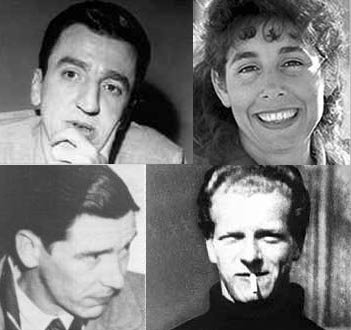
Sometimes an obscure person becomes famous by getting executed. The four cases presented here led to songs that have immortalized the mere mortal.
What's your view on the death penalty?
Should it never be used? Is it better or crueler to let someone rot in a tiny cell? Perhaps the death penalty should be reserved only for cases of premeditated murder or mass murder, such as Lennon's killer or The Son of Sam (both residing rather comfortably in New York State).
The four cases here involve an alleged rapist who never killed anyone, a druggie who went nuts with a murderous boyfriend, a guy whose partner killed a cop, and a somewhat slow man who was innocent and framed by the real killer.
CARYL CHESSMAN (top left) was a career criminal, but his rap sheet didn't include rape, and the masked "Red Light Bandit," not only robbed motorists he sexually assaulted female passengers. Caught in a car with a red light (simulating a police car's light) and unwilling to say who was using the car besides himself, Chessman was convicted of multiple felonies including kidnapping (for dragging a woman out of a car against her will). In California, kidnapping could be punished by death. And it was. Chessman fought an amazing battle to stay alive and wrote a best-selling autobiography while on death row. After many years, he finally died because a secretary mis-dialed the warden's office and the latest stay of execution was received too late. Some say a rapist deserves death, and a career criminal is no loss. Two country songs challenged the death penalty in the Chessman case (as did celebrities around the world). A reference to Chessman turns up in "The Lamb Lies Down on Broadway" Genesis album. Should Chessman have died?
KARLA FAYE TUCKER was white trash in Texas, a teen groupie with the Allman Brothers Band, later a heroin addict and prostitute. She lived in a slum where everyone did drugs, and a Harley dripping oil and stinking of fumes was safer in the house than outside. Karla hated the guy who owned the Harley, especially since he routinely beat his wife (a friend of Karla's). Karla and her latest boyfriend planned on wrecking the guy's bike, but after a binge of drugs, they beat the guy to a pulp, along with his latest girlfriend, who had been hiding in the darkness. In prison, Tucker was apparently "born again," and many insisted her early environment had much to do with her crime. If various bloody female followers of Manson could escape the death penalty, how about a reprieve for Karla? After 15 years on death row could anyone say she was the same person she once was? Her pleas for mercy were ignored by Gov. George W. Bush who declared: "Karla Faye Tucker has acknowledged she is guilty of a horrible crime. She was convicted and sentenced by a jury of her peers. The role of the state is to enforce our laws...May God bless Karla Faye Tucker and may God bless her victims and their families." Should a messed up woman's one night of brutality mean execution?
In Great Britain, Tim Evans died in 1950 and Derek Bentley in 1953. Ewan MacColl wrote protest songs after the executions, focusing on the glaring injustices in both high-profile cases.
TIM EVANS (lower left), his wife and child, lived uncomfortably in a poor walk-up apartment. Their arguments were heard by a neighbor, Dr. Christie. When the police found the body of Mrs. Evans, and the child, Tim was long gone, on the advice of the good doctor. Frightened during interogation, and not having much to live for, he confessed. Then he recanted. Ewan Maccoll's brilliant song (alternately called "Go Down Ye Murderer") seems to follow, with justifiable vengeance, the execution of a murderer. The song was recently covered by Karan Casey. Should Evans, with a previous clean record and protests of innocence, have gotten the death penalty?
Teens DEREK BENTLEY and Chris Craig were just a pair of Croydon punks. During a warehouse burglary gone wrong, they were stopped by a policeman. Craig waved his gun. Bentley shouted, "Let him have it, Chris." Meaning, hand over the gun? Craig chose the slang meaning, and shot the cop dead. He was a bit under the legal age for a hanging, but not Bentley. Though he had not fired the gun, Derek was deemed just as guilty as Craig. MacColl's song seethes over the boy's death while the chorus grimaces at the comic books and violent films that "educated" the young criminals. Elvis Costello re-visited the case and wrote his own version ("Let Him Dangle') decades later. Should Bentley, or anyone, get the death penalty when they haven't actually killed anyone? Chris Craig served ten years in jail and has not been in trouble with the law since.


CARYL CHESSMAN - Ronnie Hawkins
CARYL CHESSMAN - Country Johnny Mathis
KARLA FAYE - Mark Knopfler
KARLA FAYE - Mary Gauthier
BALLAD OF TIM EVANS - Karan Casey
BALLAD OF TIM EVANS - Ivy League Trio
GO DOWN YE MURDERER - PADDY REILLY
BENTLEY AND CRAIG - Ewan MacColl
LET HIM DANGLE - Elvis Costello

Friday, March 09, 2007

SACRELIGE #4 Simon & Garfunkel Satire


"Hello darkness, my old friend."

A message left by Art Garfunkel on Paul Simon's answering machine? For those who continue to continue to pretend that friendships never end, and that flowers never bend with the rainfall, I suggest you NOT download this celebration of Simon hating Garfunkel and vice versa.

Those mature enough to realize that often the only thing that keeps a relationship going is a mutual need to make a little cash, here's hoping you'll like "Here's Hoping." It was performed on England's "Not the 9 O'Clock News," about 25 years ago. At the time, Paul and Artie were tolerating each other for a tour, which wasn't helped by a British TV interviewer asking Garfunkel about all those great songs he wrote. That's probably why this satire has Paul very prominently declaring HE wrote all the material.

ILLFOLKS declares that the Photoshop job on the picture above is also satire.

Simon and Garfunkel created some great songs together. Their solo work can be enjoyed at home or while exercising in Paul-Artie's classes. So at the illfolks blog, the joke is on those who still don't get it; people will grow, mature, and sometimes start disliking and avoiding each other. Call it a'pauling, or art-istic, but it happens, and here's some fun over the feud...

Instant download: Simon and Garfunkel HERE'S HOPING

LILY OF THE WEST Murder Ballad x 10


Boy meets girl. Boy loses girl. Boy kills rival. But that's not the end of the story: "still I love my faithless Flora, the lily of the west." Boy, is this guy gone. In fact, soon he'll be executed. [SHE will be executed, too, in the case of the "lesbian" versions from Joan Baez and Rosanne Cash]

The setting for this well known "crime of passion" song is Louisville for American folksingers, but its origins are in the U.K. circa the 1830's. The Irish ballad cautioned against journeying South: "Twas when I came to England, some pleasures for to find..."
In the original, our hero merely loves and loses Flora:
"I courted her a fortnight, in hopes her love to gain, But soon she turn'd against me, which caused all my pain. She robb'd me of my freedom, she robb'd me of my rest, I roam, forsook of Flora, the Lily of the West."

Within a few decades, and with broadsheets popularizing murder ballads, the tune was revised to include mayhem. The upper class is blamed, since Flora falls for a "lord of high degree." Our hero sees red, and acts rashly. Or has a rash, and sees red:

"I walked up to my rival with a dagger in my hand, And seized him from my false love, and bid him boldly stand; Then, mad with desperation, I swore I'd pierce his breast, And I was betrayed by Flora, the Lily of the West."

(Yes, you can click the picture and see a larger version of the sheet about this broad Flora). As with "Stagger Lee" and "Tom Dooley," more than one musical setting can accompany these lyrics. The less popular version (the one resuscitated by Mark Knopfler, and the one used often by Irish traditionalists) seizes the melody more commonly associated with the old air, "Lakes of Pontchartrain." With this 10-version download you get "Lakes of Pontchartrain" with its own far less murderous original lyric, so you can compare it to the versions here that borrow from it. Over the years Flora's been re-named "Maire" or "Mary-O" or "Molly-O," but "Flora," after all, is more likely to be a "Lily" of the west.

Geography students can worry over how far "west" Flora might be in relation to Louisville.
Once the song was transplanted into a Kentucky ballad of the Old West, the slimeball that Flora was fooling with was changed from a "lord of high degree" to "a man of high degree" or, worse, "a man of low degree." Either way, Flora served most definitely as a witness for the prosecution! Which suggests the Groucho line, "I was fighting for your honor, which is more than you ever did." The song wouldn't be nearly so compelling if the guy didn't still love her, setting up over a century of similar (if not always lethal) songs of agony.

In American versions, the pain is that the gallows await while the singer woefully declares he still loves his "faithless Flora." One Irish version actually spares the guy...no wonder it isn't popular:

"I then did stand my trial, and boldly I did plea. A flaw was in my indictment found, and that soon had me free. That beauty bright I did adore, the judge did her address, He said "go you faithless Molly - O", the Lily of the West Now that I've gained my liberty, a roamin' I will go. I'll ramble through old Ireland, and travel Scotland o'er. Though she thought to swear my life away, she still disturbs my rest, I still must style her Molly - O, the Lily of the West."

That's the version from Alex Beaton and from The Chieftains with the Ponchartrain melody. In most others, the guy has been found guilty thanks to Flora's eye-witness testimony, and poor boy, he's gonna die. Whether you prefer Bert Jansch, Pentangle, Steve Forbert, Rosanne Cash, etc., a special doff of the hangman's cowl goes to Peter Paul and Mary who recorded it on their best-selling album "Moving." It gave the old number a fresh new audience and probably inspired most of the cover renditions. Their version may have a little extra resonance since it's the only one that, unintentionally, echoes the love triangle of the story. Peter and Paul harmonize like dueling rivals, while Mary's alluring refrains suggest how haunting Flora was, and how easy love lost became life lost.
R-share: 10 LILIES OF THE WEST and a PONCHARTRAIN

Beatles! "You Know My Name" In FRENCH


We like art collages, but tend to be baffled by sound collages. Odd, isn't it?
When The Beatles snuck "You Know My Name, Look Up The Number" onto a B-side, it sounded like a recording of somebody spinning the dial between "Top of the Pops," "The Goon Show" and shortwave radio.
Yet, being a Beatles song, it was dutifully covered by other artists. Here is the French language version by one Gerard Saint-Paul (unless it's two, Gerard and Saint-Paul). What do you think it sounds like? Sort of Deja vu in French? Could it also be Groovy Fab?
It's on Volume 2 of "La France Et Les Beatles" which is up to four volumes already. Sapristi! Gerard also recorded Rentre Jojo a la maison (Get Back) and C'est beau Paris (Come Together), while Ringo Starr sang "Beaucoups of Blues." I wish my French was good enough. I'd tell you so much more.

Gerard Saint-Paul - Dis moi je t'aime.

Monday, February 19, 2007

A HERRING and A DOMINO (Anne and Anna)


It's Anna Domino and Annie Herring.
And rather than do a Lawrence Welk impression by introducing "Anna one, Annie two," let's get the facts out of the way, fast. YOU may not have heard of either, but they have been in the music biz for 20 (Domino) and 30 (Herring) years now.

Herring is a Christian singer-songwriter, so chances are you'd know her if you feel more positive about Oral Roberts than oral sex. All her recordings are on Christian record labels, but don't label her a Jesus freak. Take the perky, pretty "Wild Child," from her very first album. It's faster than a pirouetting rodent and filled with the kind of free-wheeling glee that most will only get after an uplifting morning in church or an upshot of Summers' Eve.

Is it a sin to download this out of print bit of Herring? What would Jesus do?

Like many contemporary Christian singers Annie's lyrics are not always overt in referencing that Son of you-know-who. (Parenthetical note: the grand Rebecca St. James scored a massive contemporary Christian hit via "Me Without You," which SHE thought was about God. The songwriter, Martin Briley, was just writing a love song to a very real You. But the Lord moves in mysterious ways).

As sung very fast by A. Herring:

WILD CHILD I always wanted my life to look like the right side of a tapestry, a tapestry, But darkness was weaved in when I was conceived in iniquity. And now I wanna be cut free... You took me out of hell when you tore through my veil And now all I can do is just look at you And be me for the first time. I feel like a child that's never gone wild. And I feel pretty in my soul The darkness is gone And what keeps me hangin' on is you. And that's all I want..."

As for Anna Domino, she's had a cult following for twenty years, which means she can pretty much walk around unnoticed. Her real name is the less ecclesiastical Anna Taylor. Her style of indie-pop, at least on the cut you're about to hear, puts her somewhere into the Joni Mitchell category of someone cool, literate and aloof.
Born in Tokyo, raised in Ann Arbor, Michigan, she gravitated to Manhattan and worked with various indie rock bands, releasing her first full length album in 1986. "Own Kind" is from that vinyl.

She has since gone on to record some interesting stuff with her husband Michel Delory (check out Favourite Songs from the Twilight Years 1984-90). In 1999 the duo re-named themselves Snakefarm and released "Songs from My Funeral," filled with traditional folk songs and murder ballads.

OWN KIND Here we are polite well informed and mannerly All our boys and girls have money and enough to eat And weave a thread through the whole community Showing how we value heredity And what it means to belong to a fatherland Know the aborigine, colourfull but out of hand And now and then others come and threaten us And we fall back on forces we can trust And we shake our fists at the posters on the barroom wall We display our public grievance In the editorial page or else we paint it on a subway hall. We look upon the world but we're not quite part of it All the trouble there surely isn't our fault All the pain and hate and the needless punishment We've grown out of that and we're quite proud of it And something else that should well bear mentioning Once we were on top fashionable and interesting And we held sway over half this ship of fools Subject to our values myths and rules We know we can't afford to lose the past So full of moral lessons we thought would always last But now so many years without a war We have a generation A generation rotten to the core.

Instant song download ANNA DOMINO

Instant song download ANNIE HERRING

JIMMY CAMPBELL - Completely Baked


Liverpool's Jimmy Campbell has died (January 4-1944-February 12, 2007). He once said, "A lot of my songs are cries for help, and I suppose that's why they didn't make the grade." Unlike his contemporaries Don McLean and Gilbert O'Sullivan, Campbell wasn't commercial with his romantic tunes, solemn rock numbers or bleakly timid brand of self-pitying ballads.

On the cover of "Half Baked," he's the tragic clown, but whether he was trying to be a shoegazer version of Anthony Newley or just a rival to other grim singer songwriters of the day (Andy Bown, Matthew Fisher, etc.) he never even got a U.S. record deal.
Campbell's frustrations began when he was part of The Panthers, a group that played on the same bill in 1962 as another Liverpool group, The Beatles. Two years later the struggling Panthers appeared on the radio, but the announcer introduced them as The Kirkbys, because that's the district where the band was from. The band changed their name to The Kirkbys, and recorded "It's a Crime" on RCA. They even toured with Herman's Hermits. Some of Campbell's songs were recorded by The Merseys ("Dreamin'" and "Penny in my Pocket").
When the times turned psychedelic, the band became 23rd Turnoff and Deram released "Michaelangelo." Next, Campbell was in Rockin' Horse and ultimately solo'd with less than successful albums from 1969-1972. His later years seem to be a cloud of too much smoking and drinking.
His death was a surprise for those who didn't know he was even ill, but I always thought he was pretty ill, and your download of two pity-me tracks from "Half Baked" should prove it. This is not a mock; we all want some sympathy now and then, and many a favorite song of ours is a woe-is-me lament, from "Alone Again Naturally" to The Beatles' "Girl" or REM's "Everybody Hurts."
On "Dulcie, It's December" he says: "I've just crawled out the bath, I'm shining and clean like a summer raindrop." At least, I hope this is a phone call and he's not in her bedroom. He says he's not as neurotic as he used to be: "What used to bother me then doesn't bother me now."
Next, "Forever Grateful," once again has him begging for "a helping hand" because "Hope no longer spreads its wings to help me through the day."
Jimmy Campbell is feeling very sorry for himself on "Dulcie" and "Forever Grateful," but now that he's dead, you can feel sorry for him, too.
I went to my shelf to get some vintage whine for you. From the original vinyl, no Rabidshare, an instant download,
Two Half Baked Songs by Jimmy Campbell.

MURDER BALLAD - Judy Henske Peggy Seeger


It's a killer: Rhino Handmade has just released "Big Judy," a 2 CD overview of Judy Henske's legendary career. I will buy it even though it's expensive. $40 for a lifetime of Judy is money well spent, compared to a half hour massage, a few games of bowling or one bad meal and a few drinks one night.
Henske, her mighty oak height and powerful voice making Janis Joplin seem like a willow in comparison, belted folk, sang jazz (on "The Judy Garland Show") and made a legendary psych-rock-folk album called "Farewell Aldebaran." Her offbeat humor earned her the title "Queen of the Beatniks." She was also the inspiration for "Annie Hall" (Judy and Woody Allen made an unlikely pair, but they were a combo for a while. They appeared together in an obscure issue of the magazine HELP; the photo of Judy on this page is from that issue.)
"Little Romy" isn't on the 2 CD set. It's a nice example of her ill folkie twisted humor. Most artists adapted old songs and modernized them. Here, Judy updated "Omawise."
Since I know you're the scholarly type, I've included Peggy Seeger's traditional version so you can compare the two. Seeger (half-sister to Pete, wife to the late Ewan MacColl) went on to write one of the best modern folk songs of all time, "Ballad of Spring Hill" which has been covered by everyone from Peter Paul and Mary to U2.
Two murder ballads!
OMAWISE Peggy Seeger
LITTLE ROMY Judy Henske
These are non-Rabidshare files, instant downloads. For more information (and product) on these two living legends, visit the dot coms for Judy Henske and Peggy Seeger.

Friday, February 09, 2007

The South African Dead Baby Song


It's the first anniversary of the ILLFOLKS blog.

What better way to celebrate than with an ill folk song?

"Siembamba" is sort of the South African version of "Rockabye Baby." We don't mind crooning to our kids about a baby hauled into a tree, and then falling to the ground when a limb breaks. Guaranteed, baby breaks a few limbs, too.

And so in South Africa, there's an equally charming old folk song called "Siembamba."
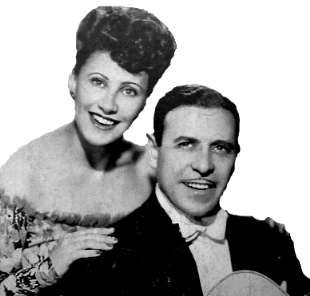
The genteel, nearly forgotten husband and wife team of Marais and Miranda recorded it, both studio and live versions.
Goodwill ambassadors for South Africa, and fluent in songs involving Dutch and African languages, Marais and Miranda popularized "We Are Marching To Pretoria," "The Zulu Warrior," and many other songs nobody knows anymore. You can find most in the dollar bin of any record store that is still in business, and in thrift shops all over the world.
South African Josef Marais (Nov 17 1905 - Apr 27 1978) and Amsterdam native Miranda (Rosa Lily Odette Baruch de la Pardo, Jan 9 1912 - Apr 20 1986) were kindly people. They used to sing a folk song about "Johnny with the Wooden Leg," but after the war, and mindful of injuries suffered by soldiers, they updated the lyric to "Johnny with the bandy leg." They dressed like classical concert artists, and almost never performed anything that could be considered tasteless.
Almost never.
For any of you who are Dutch/South African, you'll recognize these lines:
Siembamba - mamma se kindjie
Draai sy nek om gooi hom in die sloot
Trap op sy kop dan is hy dood
The rest of you will just have to download this ditty to hear the English translation.
And so, with over-population a threat to kill us if global warming doesn't, the ILLFOLKS blog happily presents....
The delightful dead baby lullaby SIEMBAMBA.

18 Versions of STAGGER LEE

They all did it: Fats Domino, Lloyd Price, Wilson Pickett, Pa Boone, Theodis Ealey, Sleepy LaBeef, Nick Cave, Downchild Blues Band, Grateful Dead, Jerry Lee Lewis, Bill Wyman, Dave Van Ronk, Bob Dylan, Mississippi John Hurt, Ma Rainey, Elvis Presley, PJ Proby, and John Fogerty. They weren't the only ones, either.
Like Mack the Knife, Stagger Lee was not someone to be admired, yet the song about him is so cool people can't help boppin' and smilin' when they hear it.
Yes, there was a Stagger Lee.
Was there a shooting in a bar? And did it involve a Stetson hat?
Well...the famous song is rooted in truth.
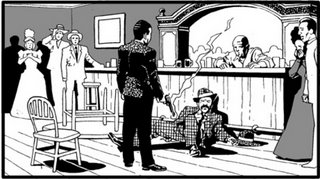
The story was reported in an 1895 issue of the St. Louis Globe Democrat (what, you were expecting me to quote some crap from allmusic.com? Not on THIS blog). Here's how they reported it:
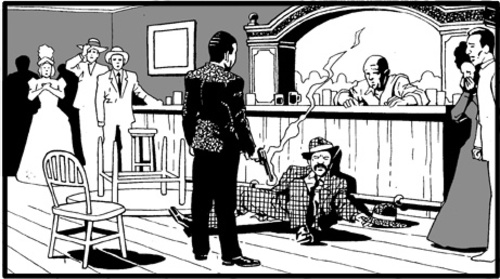
"William Lyons, 25, a levee hand, was shot in the abdomen yesterday evening at 10 o'clock in the saloon of Bill Curtis, at Eleventh and Morgan Streets, by Lee Sheldon, a carriage driver. Lyons and Sheldon were friends and were talking together. Both parties, it seems, had been drinking and were feeling in exuberant spirits. The discussion drifted to politics, and an argument was started, the conclusion of which was that Lyons snatched Sheldon's hat from his head. The latter indignantly demanded its return. Lyons refused, and Sheldon withdrew his revolver and shot Lyons in the abdomen. When his victim fell to the floor Sheldon took his hat from the hand of the wounded man and coolly walked away. He was subsequently arrested and locked up at the Chestnut Street Station. Lyons was taken to the Dispensary, where his wounds were pronounced serious. Lee Sheldon is also known as 'Stag' Lee"
Yes, it's all right there. Even the nickname, "Stag" Lee.
Billy Lyons died from the gunshot wound. Stag's first trial was rousing and raucous, and featured the antics of Mr. Dryden, Stag's opium-addicted lawyer. The trial ended with a hung jury, but the second time, sans the colorful Mr. Dryden, turned out badly for 'Stag" Lee, and his sentence was 25 years. He got out early, went back to crime, pistol-whipped a thug, and was returned to state prison where he died in 1912, aged 46.
Scholars have since discovered that Stagger Lee Sheldon was actually Lee SHELTON, probably a pimp more than a gambler, who was born in Texas, on March 16, 1865. His posse was called The Stags. An early folk song about him started like this:
"Staggerlee was a good man
Everybody he did love
The pimps and whores all swore by Stag -
By the everlasting stars above..."
In 1911 Guy B Johnson published a version of the song in the Journal of American Folklore. Frank Hutchison recorded a version in 1927 and Mississippi John Hurt did one in 1928. Along the way, others made free and easy adaptations, some with fresh lyrics or a different melody.
The song kicked around until Archibald (stage name for Leon T. Gross) recorded a version in 1950. The record impressed a Korean soldier by the name of Lloyd Price. He decided to use the song in his act: "While entertaining the troops, I had put together a little play based on it. I'd have soldiers acting out the story while I sang it.".
Price recorded his version of "Stagger Lee" on the B-side of a single called "You Need Love," and disk jockeys literally flipped for it...turning the B side into a hit. It was Price who came up with the enthusiastic "Go Stagger Lee" chorus chant, and that cute doo-wop intro, setting the scene with a yellow moon and leaves tumbling down. He placed the gambling outside "in the dark," then brought the argument indoors to the bar.
When suits felt the song was too violent for "American Bandstand," Price recorded a sanitized new version with a happy ending. That version is, fortunately, pretty obscure now. Not so obscure is the home of Stag Lee Shelton (911 North 12th Street in St. Louis) or the grave of Billy Lyons at St. Peter's Cemetery. They are tourist attractions.
Lloyd Price's version presents Stagger Lee as a gambler who is pissed off at losing all his money to his cheating friend Billy ("Stagger Lee threw seven, Billy swore that he threw eight"). Other versions have made him more heroic. During the Black Panther era of the late 60's, Bobby Seale declared, "Stagolee was a bad nigger off the block and didn't take shit from nobody. Malcolm X at one time was an illegitimate hustler...So symbolically, at one time he was Stagolee...To me, Stagolee was the true grassroots."
Nick Cave's recent recording of the tale is ultra-violent and homo-erotic. He says: "The final act of brutality, where the great Stagger Lee blows the head off Billy . . . while he is committing fellatio [was] especially attractive...There's a verse to our version that goes, 'I'm the kind of cocksucker that would crawl over 50 good pussies to get to one fat boy's asshole,' which I heard on an amazing talking blues song by a guy who, in the song, introduces himself as Two-time Slim. I've always thought that was a groovy line so I just threw it in for good measure...I like the way the simple, almost naive traditional murder ballad has gradually become a vehicle that can happily accommodate the most twisted acts of deranged machismo. Just like Stag Lee himself, there seems to be no limits to how evil this song can become."
Nice guys don't get 18 versions of a song about 'em, because nice guys generally aren't prone to killing people over a hat. That's the stuff of legend, and a touch of wistful admiration. There's allure to being a "bad man," and Stag was one bad, bad cat. Hell, he not only put a hole in Billy, it went through and broke the bartender's glass! Hmm. Single bullet theory...was Stagger Lee really the lone gunman? How old IS Phil Spector??
The night was clear, and the moon was yellow. And the leaves came tumblin' down!

The Late Great FRANKIE LAINE


The motto at Frankie Laine's website: "It Ain't Over 'Til It's Over."
And it isn't, even though Frankie died on February 6th, at the age of 93. His unique stylings will continue to amaze and amuse. Time may dim his luster a bit, just as Al Jolson and "Swanee" play to a smaller crowd, but for those of us with a taste for bombast, heroics and yes, a bit of corn, we'll still be playing "Call of the Wild Goose," "Mule Train," and "Jezebel," and feel at least agnostic rather than atheist in hearing "I Believe."
Francesco LoVecchio was born on March 30, 1913, and in his lifetime 21 of his records went gold and he sold over 250 million discs. If he had remained Frank LoVecchio, none of it might have happened, or at best he would be remembered as another Italian pop singer.
But as Frankie Laine, he emerged via Mercury Records as a soulful balladeer, and some figured from his style and his name that he might be black. He sang "Shine," after all, along with "Georgia On My Mind" and "God Bless the Child." He also sang numbers that now seem like soundtracks to noir movies, notably "Satan Wears a Satin Gown."
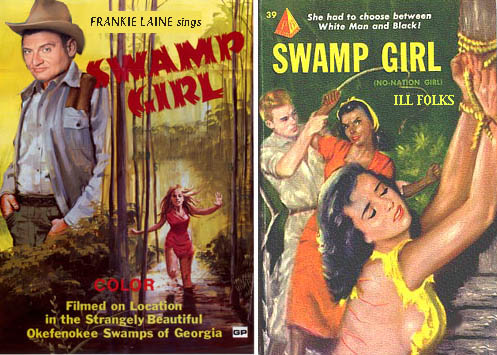
He really defined himself by three immensely insane singles at Mercury: "Cry of the Wild Goose," "Mule Train" and "Swamp Girl," each of them as lurid and evocative as the cover of a bad paperback novel. These songs gave "Frankie Laine" an identity. He was America, the guts of the country from the bayous of Louisiana up through the parched dirt of Texas. While he would have a hit here and there with "That's My Desire" or "I Believe," and issued many romantic albums for Columbia, he was better known for belting out "Rawhide" and the story-songs for "High Noon" and "Gunfight at the OK Corral."
As ludicrous as it might be, he melded his operatic and Italian tendencies to these gritty ballads, and like Roy Orbison, was somehow able to make a theatrical run up and down the scales into something both pretty and masculine. No ordinary country singer could've or would've flourished the ending of "Gunfight at the OK Corral" the way Frankie did. He got away with it like a bandit. Even the album covers where this guy was dressing up in cowboy outfits and brandishing a gun seemed authentic rather than ridiculous.
To cap off his career, he gave an exciting, serious rendition of "Blazing Saddles," knowing full well that the lyrics made no sense and Mel Brooks was filming a comedy.
I wrote to Mr. Laine some time ago, expressing my admiration for his work, and I'm glad I did. I'm glad he responded, too. The man was still active at 90, and he had loyal fans and a loving family and a long life. It takes a very special performer to make a hit out of some of the tracks that Laine became famous for.
If you want to see him put his heart and soul into a song, watch him deliver "Lord, You Gave Me a Mountain" on David Steinberg's "Music Scene" TV show (on DVD). If you've admired Frankie Laine you probably have a lot of his CDs, and thank you for buying them. It let him know in his 70's and 80's and even 90's, that he was not forgotten, and that the bottom line was the royalty check that proved it.
He never got the respect he deserved. He covered a lot of territory, from jazz to pop to C&W and inspirational songs, and he was as effective with intimate songs as with the bombastic ones. Tony Bennett's practically The Pope these days; I wish sometime in the past decade, somebody brought Frankie Laine center stage for a worthy tribute.
I've chosen "Swamp Girl" for you, because she straddles the fragrant bog between Laine's romantic and jazz side, and his often blinding flare for the dramatic.
He was a great American artist.
SWAMP GIRL

Monday, January 29, 2007

U-NEE IS GONE


U-Nee hanged herself a week ago.
Fans of the albums she released in 2003 and 2005 were expecting something hot from their Korean pop idol in 2007. She had mirrored Christina Aguilera and other dance-pop divas who stoked libidos while studio musicians scratched up beats.
Like Aguilera, who was smart enough to drop the "skank" act before it killed her, U-Nee was having second thoughts about the way "sex goddess" simply becomes "ho" or "pop tart" or some other derogatory term.
After dutifully posing in leather and filling her tracks with the standard sexy tricks, U-Nee sent out a storm warning last year: "I'm going to come back with an improved self. I want to try shedding the sexy image I built for myself and bring a new image to my fans."
Her good intentions were destroyed by an incident that happened far away in Malaysia. That's where Altantuya Shaaribuu was murdered in October of 2006, her body blown to bits by explosives, identified only through DNA. Shaaribuu, a part-time model, was having an affair with Abdul Razak Baginda, a defense analyst. Did he kill her, did he assign a high-placed hitman, or was there a government conspiracy?
Adding insult to the fatal injury, sexy pictures of U-Nee were circulated as being secret poses of the late Altantuya. When the Malaysian woman's father declared, "That's not her...don't spoil her name," the backlash against U-Nee was like a tsunami.
Anti-U-Nee websites appeared and she was swamped with hate mail. U-Nee was already suffering from depression from her low image, the pressures of fame, and her workload in preparing her third album.
She left no note. Probably the day she died her computer was flooded with headers of hate and derision over her sexy pictures "defaming" the memory of a woman she never even knew. The trial of Altantuya's alleged murderer is scheduled to take place in 2008.
The singer who was born Heo Yoon May 3, 1981, died as U-nee, January 21, 2007.
Now you know the basics of her story.


You'd like to hear her sing?
U-Nee had a unique name but was pretty similar to every sexy female from Christina Aguilera to Mylene Farmer to Madonna, mixing techno, rap and pop, adding bonus tracks re-mixing with thumps and sound effects for the disco/dance crowd.
Her first album, "Code" has a song called "Oh Punch" that owes a bit to Britney Spears' "Hit Me Baby One More Time," while the song "Play," samples American Black phrases and "Go" is spiced by male rappers shouting "When I say Hey, You say Ho." Or something like that. On her second album, "I Want You" is a chaotic combo of rap grunts from men and upbeat sass from U-Nee. "One" opens like everyone's American Idol ballad and overflows with power pop anguish. She often imitated the phrasings of young black and Latina performers, using deliberately flat-voiced male rappers for ghetto cred.
The Illfolks choice is "Don't Cry Again," which flirts with disco, has a traditional Asian minor key melody, uses a bit of synth and a dash of rap-scratch and halfway through switches from Korean to English.
Now that's covering a lot of bases! It might reflect the fractured nature of K-Pop, which keeps turning away from traditional Asian tonalities to mimic all the latest trends coming out of America. At least "Don't Cry Again" has some of the tantalizing dabbling into sharps and flats that you expect from Eastern melody, and U-Nee doesn't try to get too ghetto in her phrasings. If you need to hear U-Nee...
DON'T CRY AGAIN is one of U-Nee's most universally accessible songs

SACRILEGE #3 : A JAMES TAYLOR PARODY


Continuing the series of "how can they make fun of our idols," here's Chris Guest skewering Sweet Baby James. "Highway Toes" was performed in a National Lampoon revue called "Lemmings," a parody of Woodstock. The cast album has been re-issued on CD.
Mr. Guest is more familiar to you from "Spinal Tap" and his work (pictured) in the folk-music satire "A Mighty Wind." He has written, directed or starred in many cult-favorite movies and is responsible for giving Jamie Lee Curtis orgasms.
Here he has some fun with the commercial brand of vulnerability exuded by the Sweet Baby's damaged-goods lyrics, nasal delivery and timidly genteel guitar playing. When it came to being the sad singer-songwriter every co-ed wanted to cuddle, James Taylor used a full arsenal of soft-pop effects. His arse gets a full booting thanks to Chris Guest, who is clearly being less than sensitive.
How could he make fun of James Taylor??

Pre-Kate Bush: Mellow MALAMET


Aside from opera sopranos, only Kate Bush became famous with a voice that hit wuthering heights. Marsha Malamet, after all, is not a household word. Marshmallow, yes. Mallomars, yes. Marsha Malamet, no.
Some 6 or 8 years B.B. (before Bush), Marsha issued her lone album "Coney Island Winter," with a suitably bitter picture of her on the inside. Somewhere too far East of Judy Collins, North of Carolyn Hester, South of Julie Budd and North by Northwest of Buffy Marie the Saint, Malamet got lost.
The album is as obscure as "The Goodbye People," the failed Milton Berle-Brenda Vaccaro Broadway play about a guy trying to open a beverage stand in Coney Island, in winter. Herb's play wasn't bad, and it's possible if Marsha looked more like Kate Bush, she would've floated a while longer, like a decorative marshmallow in hot cocoa.
Malamet later co-wrote "Love Don't Need a Reason" with Peter Allen (not that there's anything wrong with that), and she's become a yenta who'll sing that song any time anyone asks, and they do, at various gay fundraiser events.
The chosen song is nowhere near the schmaltz level of Peter Allen. It's what Kate Bush might've done if she was more into Judy Collins. Note the effectively self-conscious solo piano work and how the orchestration colors itself into the mix. It's winter. Her voice will give you a bit of a chill. And "I Don't Dare" should never be a final answer if you've got a dream. Decca thought enough to sign her, and on this blog of the forgotten, this miss's near-miss is not misbegotten.

Malamet sings I DON'T DARE Do you? Instant Download. No codes, forwarding links or ads.

BOB DILDYN RADIO THEME HOUR: VAGINA

Premiering the same day as the release of "Modern Times," the BOB DILDYN RADIO THEME HOUR offers a compilation of songs about the Vagina. Not to mention mock cut-in interviews with Leonard Cohen and Madonna.

Bob's cogent commentary on "the mighty quim" prefaces many of the selections, which include:

It's All Right It Won't Bite
Cameltoe
Pretty Purple Panties


Shave 'em Dry
My Girl's Pussy
Red River Sally
We Are the Tampons
Rotten Fish
My Vagina
Step Inside Love
I'm a Lesbian
The Pussy Cat Song

As well as Bob's own "When Dogs Run, Freak," which evidently is on his Debasement Tapes release. As John McEnroe used to say about cable radio, "You can NOT be SIRIUS!"


Re-upped for 2007:
Bob Dildyn!
Re-upped in 2011:
Bob Dildyn, via a good server who won't remove the file if it isn't downloaded every day

Friday, January 19, 2007

CAN'T STAND YA


You can put any type of crap on a turntable, and SOMEBODY will gladly lap it all up. Here's an endurance test...see how many of these tunes you can stand.
Some, like "Shaddup You Face" are love it or hate it novelties. A few, like "Sunshine Face" from a woman better known for her sexy album covers than her taste in music, are like Crackerjack...sweet and then sickening the more you have to endure it. Some may be intentionally irritating ("Fluffy") or an experiment that ends up being a terror (the ambitious "Andy the Lightbulb Eater").
As David Seville once remarked..."That's almost good."
"Catchy" or "kitschy" or just plain crummy, here are some tunes that will get your attention or cause you tension:


1. Agadoo (Black Lace)
2. Son of My Father (Chicory Tip)
3. Billy Don't Be a Hero (Paper Lace)
4. Mouldy Old Dough (Lieutenant Pigeon)
5. Lily the Pink (Scaffold)
6. Chirpy Cheep Cheep (Middle of the Road)
7. Macarena (Los Del Rio)
8. So Macho (Sinitta)
9. Orville's Song (Keith Harris)
10. Two Little Boys (Rolf Harris)
11. No One Quite Like Grandma (St. Winifred's School)
12. Mr. Blobby (Mr. Blobby)
13. Snot Rap (Kenny Everett)
14. We're Going to Spain (the Krankies)
15. Hello (Marguerita Pracatan)
16. Seven Drunken Nights (The Dubliners)
17. Cinderella Rockefella (Esther and Abi Ofarim)
18. Music Goes Round and Round (Mae Questel)
19. Fluffy (Gloria Balsam)
20. Shaddup You Face (Joe Dolce)
21. My Icelandic Man (Leoncie)
22. Where's My Love (Caroline)
23 Andy The Lightbulb Eater (Elisa Korenne)
24. Sunshine Face (Sandy Warner)

Via RS. Who put that crap on my turntable??
Now it's on MP3!

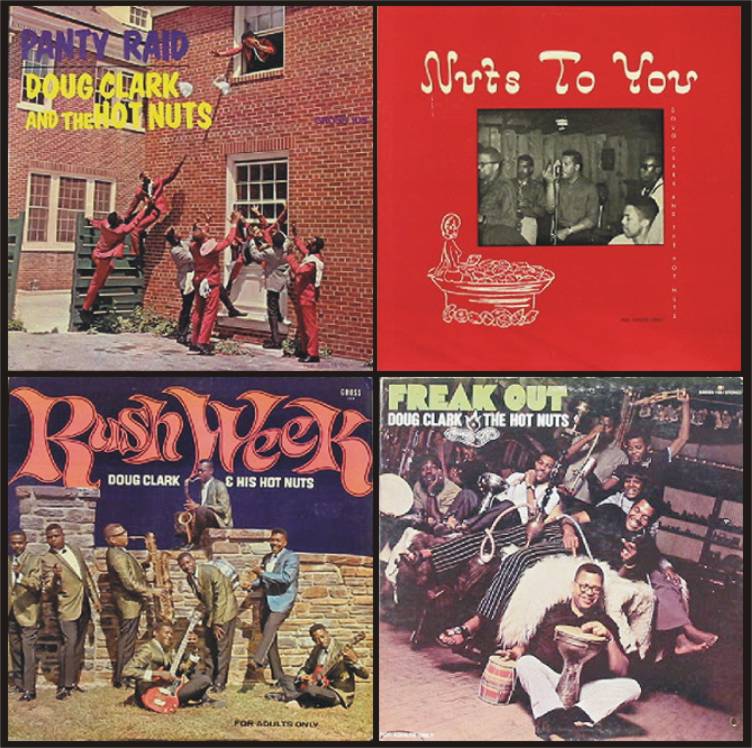
DOUG CLARK and 2 HOT NUTS tunes


The Godfather of Smut, soulful Doug Clark was active for over 45 years, offering laidback limericks, gross versions of garage band classics, and funked up versions of ribald old folk numbers like "Shove It Home" and "Ring Dang Do."
Before Blowfly or Dolemite, and before Andrew "Dice" Clay ever rapped a bad rhyme, the man from North Carolina was all over the frat house circuit with his dirty ditties and rude recitations.

Clark was more amiable than offensive, and even had a female singer along at times. Which is why I hope somebody films his life story and gives the leads to Kevin Eubanks and "Tonight Show" vocalist, percussionist Vicki Randle (an admitted lesbian, which does open up more possibilities for the chosen sexy songs).
Doug died of leukemia on September 16, 2002 (age 66).
Just as many perverts got their first peep at pretty women via Playboy, many heard their first dirty song thanks to digging out a Doug Clark album. These two tracks are pretty quaint by the standards of today's porn rappers and sexyback vocalists. Hope you find them naughty but nice, which is a pretty solid groove for having a good time.
These are instant downloads. No mega-waiting or uploaded-to-nowhere hang time. Within seconds, you'll be hearing...
SHOVE IT HOME
And RING DANG DO

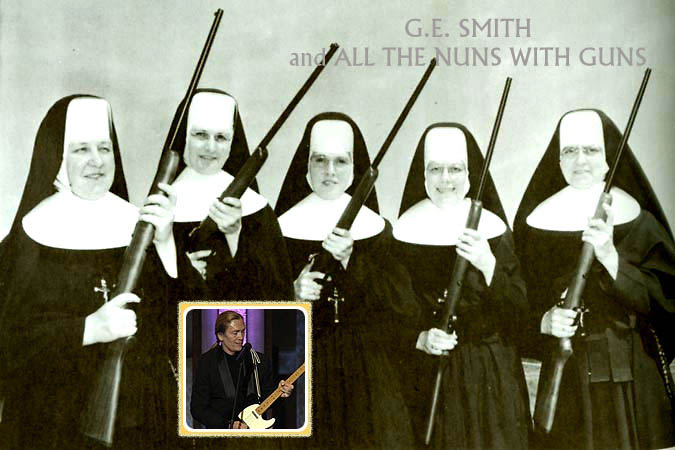
All The Nuns With Guns (& Paul Simon)


Here's a G.E. Smith song with Paul Simon on backing vocals. Even most Paul Simon fans don't know about this rarity. In fact, if you listen closely, you can hardly hear him in the mix. But he's there, and that's part of the quirk on this obscure but catchy tune.
Thanks Jim Delehant (Hit Parader/rock mogul) for handing this to me one day. Many days ago.
G.E. Smith was the somewhat crazed-looking guitarist leading the "Saturday Night Live" band (1985-95). He also married Gilda Radner, worked with Dan Hartman and toured with Hall and Oates. Among his compositions; a co-write credit on the "Wayne's World" theme song.
Smith's stinging guitar is very evident on this track, but you also get to hear him sing.
Instant dowload with no hassles. NUNS WITH GUNS


Tuesday, January 09, 2007

SPIKE MILLIGAN

Sapristi!


A brief tribute to the clown warrior Spike. Yes, Milligna, the well known typing error. The Godfather of British comedy, he influenced everything from radio's "Round the Horne" to TV's "Monty Python's Flying Circus." The writer and leader of radio's "Goon Show," he went on to a busy solo career including TV and best-selling books.

Both manic and depressive, Spike was one of the most complex and contradictory of comedians. He was the eye of a creative hurricane, capable of surreal jokes, aching poetry, whimsical nonsense and passionate letters-to-the-editor on a variety of issues.

Here is one of his eccentric solo songs. Many more can be found on historic and hysteric Goon and Spike CDs. You know his name, now look up the download! John Lennon loved The Goons, and you might recognize some absurdist touches that later figured into John's more light-hearted numbers. Lennon even wrote a review in the New York Times for the first volume of Goon Show scripts.

Get Gooned with an INSTANT listen or download, it's SEWERS OF THE STRAND

CINDY BEAR: CUTIE OF THE CAVE SET


Frank Milano is Yogi Bear (not Daws Butler) on this old kiddie 45rpm.
Smarter than the Average Bear, Yogi realized plundering pic-a-nic baskets wasn't all the fun he could have. As this song proves, he's now into Cindy and visiting her cave.

Why did so many cartoon characters wear a tie...but no pants?
CINDYBEAR! Instand upload. No Rabidshare or Code to Write

ACTOR SUICIDES: Boyer and Sanders


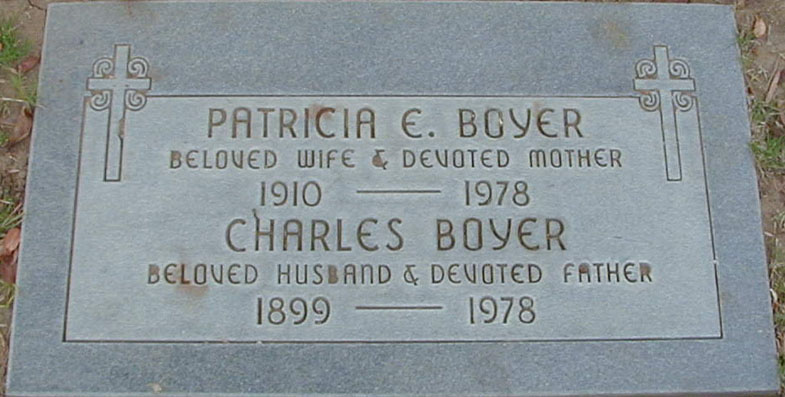
Here are songs by two famous actors who each made an unsuccessful record album, and a successful suicide attempt.
In the case of romantic star Charles Boyer, when he lost his wife, he lost all interest in life.
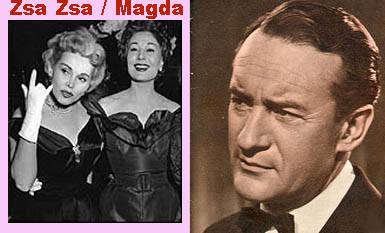
George Sanders boned two Gabor sisters (Zsa Zsa and Magda) and (some years later) penned a suicide note beginning "Dear world, I am leaving because I am bored..." and ending: "...I am leaving you with your worries in this sweet cesspool. Good luck."
Charles Boyer talk-sings the moving and ironic "Softly as I Leave You."
Sanders, who sounds a bit like Boris Karloff, offers "I'll See You In My Dreams."
GEORGE SANDERS SINGS
CHARLES BOYER