Wednesday, September 19, 2018

KATHY CHITTY...mentioned in "AMERICA" oom pah pah DAVID BOWIE


Do you suppose Kathy is feeling a tad old...hearing the news that her boyfriend from the 60's is in his 70's and on a retirement tour? (The same KATHY mentioned in Paul's "America" song covered weirdly by David Bowie, link below??)

Maybe she actually doesn't think about the little guy that much. Maybe she thinks too much about other things besides "Think Too Much." Ya think? 

I think she may think, "When is another obnoxious photographer from the London Daily Fail going to come out here to an obscure part of Wales, and take another unflattering photo of me? Why pick on ME when there's momentarily no wardrobe malfunction on a Kardashian and no Hadid exposing underboob?" 

Why am I mentioning Kathy? Because this is not only a music post offering a link to an odd-choice song Bowie sang as a "tribute" after 9/11, it also reviews the new bio on Paul, which didn't invade the woman's privacy by showing a photo of how she looks now. That's what TABLOIDS do, and really, SHOULD they??

It's possible that if Kathy took a long distance call and answered some questions, the new official (Paul cooperated) bio would answer any questions morbidly curious people have about her (and the song). Yet, even though asked, she chose NOT to participate in the book. 

Do you suppose if somebody from the LONDON DAILY FAIL had ASKED if she'd mind him taking a picture, she would've said yes? Of course not. So the guy snapped it without her knowing about it. Right? And after that, she couldn't sue because she's a "public figure."

Link to the London Daily Fail Article 

Since I like my readers to have an EASY time, and not have to click a link and then come back, I'll also give you the top part of the article, which is fair use, and I'll also show you the photo, which you'll see has no photo credit or copyright notice. Follow me: 


You'll also note that in the same article, the Daily FAIL used the cover of a Paul Simon album, probably without pay or permission, but DID save themselves by giving a copyright credit: 


Funny (not so much) they didn't give a credit on the unflattering image of Kathy Chitty. As Piers Morgan would say "IF I'M BEING HONEST," tabloids rarely give a photo credit because the photographer might be hounded by fans and beaten with a stick. OR, have his name out there to the point where bodyguards of stars would know him and block access by shoving him OR beating him with a stick.

The authorized "Paul Simon: THE LIFE" doesn't put a lid on any of the questions and controversies in the great man's life. The author doesn't analyze songs (even ones that have baffled people for years, like "Me and Julio"). 

The "authorized" Paul not only ignores Kathy Chitty, but ignores almost all of his wearisome bickerings with Garfunkel. He and his biogrpaher also don't explain how he and his third wife Edie ended up facing a judge in an embarrassing case of marital fighting. And NO, there's not much on the youthful first serious love affair that yielded some memorable songs.

“The Life” offers a few second-hand quotes about Kathy via a a couple she knew back then, the McCauslands. Lynne McCausland doesn’t say much: “Kathy was lovely, very gentle, very shy and quiet. Paul had his quiet and shy side, so they fit each other perfectly.” 

 Paul Simon, on a memorable SNL show, admitted that people come up to him and say “you take yourself SO seriously...” In “The Life,” his relationship with Kathy is taken so seriously that it becomes silly. While the woman refuses to talk, it turns out there's ONE THING she wanted to be in the book: the exact month she and Paul met. THAT is important: 


 “Contrary to repeated reports over the years that they met during Simon’s first trip to England in 1963 (Simon recalled simply seeing her taking tickets on the stops of the Brentwood Folk Club at the that time), they met formally in April 1964. Simon was performing at the White Swan in Romford when Dave McCausland introduced him to Kathy, a shy eighteen-year-old with long, brown hair. The date was supplied by someone close to Kathy, someone who - with both Kathy’s confirmation and permission - wanted to finally set the record straight.” 


Does that make your day? Will the month of April mean something different to you know? April, come she will? He glimpsed her in 1963, but was introduced to her in 1964. The taciturn Mr. Simon, who supposedly spent weeks and weeks being grilled by his biographer only remarks: “It felt like love at first sight. I had never felt that. It was just chemistry.” Anything else? “They may not have said anything more than hello that first night, Simon remembers, but they spent time together the next night, when she and a few other Brentwood folk fans went with him to the Troubadour club in central London, where he sang three songs.” 

Hey, the song about her says it all. There but for the grace of her go him.     

The London Daily Fail, having snapped a Chitty, didn't offer much real information other than "the 68 year-old grandmother" leads a "humdrum life...in a quiet Welsh-speaking village...in a small, detached three-bedoom house on a quiet cul-de-sac, and catches a bus each day to her job as an administrator for a technical college, where she has worked for 25 years." That's more than "The Life" tells us about her.

"The Life" doesn't quote the guy who has had a 40 year relationship with her, Kenneth Harrison. Journeying to that "remote mountain village in North Wales," the London Daily Fail reporter at least got him to admit that they have three children, and used to live in Essex. And that Kathy's fame as a muse was never amusing to her: ‘She wasn’t very comfortable with it. We’re very good friends with Mr Simon and there’s never been a rift. I was there. I was part of that crowd as the second person to meet Paul Simon when he came to Britain in 1963. "America" is the one song which we’ll never escape from because it’s a song about America losing its way.’

  
It is an irony, then, that David Bowie chose to sing "America" when thousands of Americans had just lost their way...staggering from the smoke and debris at the office buildings in which they worked at 9/11.

The song was an odd choice, as "America" is more about alienation and ennui with the American dream. Paul wrote "each town looks the same to me" about touring, but in this song, it seems like this young couple may have some moments that are light-hearted (making fun of fellow passengers) but in the end, it's "toss me a cigarette..." and read some magazines, and these famous lines: 

“Kathy I’m lost, I said, though I knew she was sleeping. I’m empty and aching and I don’t know why…”  People looking for recollections of a passionate romance between Paul and Kathy get the sound of silence, because like most anyone's puppy love, the end came because immature people eventually drift apart and find new interests, and if they remain they would only endure everyday monotony, ennui and empty yearnings. 

From “The Life” we learn…little: “In “America,” the narrator’s companion is a young woman named Kathy, which, understandably, led fans to assume that he and Kathy Chitty had taken a trip together during her visit in 1966, but there was no Simon-Kathy bus trip, Simon said. The images in the song were based on his own travels.” It’s always a little dicey, and ridiculous, to try and navigate between an artist’s fantasies and intellectual creativity, and his reality. Why be so eager to think that “America” is a journal song, and not a work of fiction?
         

They met in England, Paul had to come back to America, he later returned, and things just drifted. No big quotes from Paul or from Kathy. On page 237: “While on break, he flew to London to see if he and Kathy could figure out a way to make their lives compatible…he and Kathy acknowledged what had been apparent to them both for some time: their lives had simply drifted apart.” No quote from Kathy, of course. The author apparently couldn’t get Paul to comment further, so relies on a previous quote pried out of him by somebody else: “There was no big drama in our breakup,” Simon said years later. “I don’t remember ever having an argument with Kathy.” 

 Too bad, porn lovers, there will probably never be a graphic description of Chitty bang-bang, and how unseemly it would be to even imagine Paul Simon in the role of passionate lover. They were just a cute couple for a year or two. That's what the cover of "Paul Simon Songbook" shows you, doesn't it? She's just an old flame.

  
 Speaking of flame, the smoke was probably still in the air, and part of the core of the WTC was still glowing orange when David Bowie joined a bunch of superstars for a “Concert for New York City.” As Tom Lehrer might cynically declare, what better way of solving problems than to fire some songs at it? “Ready, aim, SING!” Some of the stars in attendance were only there because it would be good publicity.  Others sang weird defiant new songs (McCartney’s peculiar “FREEDOM”) or sing weirdly inappropriate oldies (McCartney again, doing “I’m Down.”  

 Why is the famous David Bowie on this blog of less renown? This blog of obscure performers? Because his cover of "America" was deemed by some to be inappropriate if not weird. For some reason known only to Sergeant Pepper’s ghost, Bowie sang the song with an oom-pah-pah waltzing tempo. Some androgynes in the band fluted it along with Ferris wheel wind toots. 


What was anyone expecting? A morbid twist on ground zero by re-writing "Ground control to Major Tom?" New lyrics for "Suffer a Jet City?" No, it was good enough that he was there, being a New Yorker, even if his choice of song was odd, and the arrangement odder. Who doesn’t adore Bowie, and the vocal styles that are sort of an anemic version of Anthony Newley? The Brit decided to come live in New York, and when disaster came, he sang for "America." 


DAVID BOWIE sings AMERICA - instant download or listen online. No Paypal tip whining, no grinning emoji of brattiness, no taking you to a freak site that will put spyware on you, tell you your FLASH is out of date, or re-direct you to hell.

Getting EMOTIONAL about PATTI DAHLSTROM


A check of Amazon reveals...what...Patti Dahlstrom's CD is now a $40 collectors item? Is that good news or bad news? 

It would seem like good news. If a re-issue on Patti's CD is sold out, it means there's a market for a second pressing. There's a market for releasing ALL FOUR of Patti's albums and giving them fresh, perfect CD treatment, complete with booklets. There ARE people out there who like quality sound, and who want to read a booklet and find out more about the artist and the songs. 

According to Rolling Stone, the best-selling category is no longer rock, it's rap. Second best is probably prap -- the pop-rap crap from Taylor "Look What You Made Me Do" Swift, Cardi-B and the rest of the stale tarts. Still, if rock fans can buy up the print run on a Dahlstrom album, it sends a message. PS, it would be nice if people not in the business, and with no knowledge of how it works, would stop giving away whole albums thinking it does no damage. It fucks up supply and demand, to put it politely, and can prevent rare vinyl from turning into digital CD with bonus tracks. And it can take money out of the hands of deserving artists, too.

There's a generous TWENTY songs on this re-issue:


1. Emotion (1973)
2. He Did Me Wrong, But He Did It Right (1975)
3. Sending My Good Thoughts To You (1975)
4. Get Along, Handsome (1972)
5. This Isn’t An Ordinary Love Song (1972)
6. Without Love (1976)
7. And I Never Did (1972)
8. Changing Minds (1976)
9. Give Him Time (1973)
10. Ollabelle And Slim (1972)
11. Cleveland Snow (1973)
12. Comfortable (1972)
13. Wait Like A Lady 1972)
14. For Everybody’s Sake (1973)
15. I’m Letting Go (1972)
16. Innate (1973)
17. One Afternoon (1976)
18. Rider (1972)
19. The Way I Am (1973)
20. What If (1972)


It's hard to find fault with the choices. They've included the darkly poignant ballad "For Everybody's Sake." You'll find good advice on the tender "Give Him Time" and the sassier "Wait Like a Lady." Everyone can enjoy the erotic "He Did Me Wrong, But He Did it Right," (still best in her version, though it's been covered by some very fine ladies). Also here, the elegantly wistful "And I Never Did," and two songs demonstrating the Texas girl's true grit, "Olabelle and Slim" and the moody masterpiece "Rider." Gotta love her down-home lyrics on "Emotion," mated to the exquisite French star Veronique Sanson's melody "Amoureuse."

One missing song is "If You Want it Easy." So...by way of a sample, and since it's unavailable otherwise, you'll find it below.

Some would say "but it's easy to offer the entire album. It's out of print." Yes, but if you want it THAT easy, then you're not an adult. Sure, we all "like it free," to quote Puzo (no, not Mario, the forum making money off everyone else's creativity.) "Sharing" with some of your friends is one thing. Giving away entire discographies to strangers is stealing. No rationalization about it. Look at how few record stores there are. It's galling that few vintage artists from the 70's can get into a studio and make new music without begging on Kickstarter and making it a vanity album to sell on a website or at a few gigs. Artists deserve dignity. Royalties. Respect. 

People who aren't in the business, aren't creative, aren't owners of record stores, aren't trying to make a living from music, and aren't even able to speak English because it's a second language, decide "piracy is good publicity," "artists should give away music and sell t-shirts at gigs" and "here's an album and a link to feed MY ego; I'm retired with nothing else to do but act like I'm in show biz and own music that I give away because I'm so lovable."

The inconvenient truth is that it wasn't exactly easy to get a record deal when Patti Dahlstrom was starting out. Now, thanks to ProTools, "everybody's in show biz" and everybody puts out albums and it's almost impossible for a new artist to get noticed amid the huge volume on Spotify and YouTube. 

"If You Want It Easy" is on the "Your Place or Mine" album. For those who aren't sure that true love travels on a gravel road, here's the smooth advice of Ms. Dahlstrom: "If You Want It Easy you don't want love." The album includes "Louisiana," a co-write with the well known typing error Al Staehely. As she often does, Patti shines a light in the darkness and comes up with something positive, like the line "The only chance of holding on is letting go within."

It's nice that the unique, original, and different (or, to use her unique Texas drawling pronunciation of it, "diff-a-rawnt") Patti Dahlstrom did get a Rev-ola revival re-issue. Hopefully they, Cherry Red or Omnivore will bring it back or offer a box set of all four of her albums. Patti's in the U.K. so, to use a stupid slang word, it would be ace if she's invited to the offices of ACE so they can plan a re-issue with her own album notes and recollections. How about a combo CD set and autobiography? 
 IF YOU WANT IT EASY (instant download or listen online. No dopey ego password, no dodgy spyware-malware crap, no  pop-ups or sending you suddenly to a spam page).


Sunday, September 09, 2018

PETE BEST explained by John Lennon & Paul McCartney - and MONEY


It was a nice day's week for Beatles fans, wasn't it? 

John Lennon was honored with an artless Photoshop-job commemorative stamp (long after Janis and Jimi were given better treatment). Yoko also announced a SIX CD set of outtakes from "Imagine," plus a re-imagined new print of their home movie of the same title. 

Paul McCartney went on the puppy Jimmy Fallon's show, where he teased up his "secret" NYC concert in support of "Egypt Station." EGYPT Station? Sure. Aside from Lagos, Nigeria, who wouldn't want to take a trip to, or promote calm, stable Egypt? A few nights after the Fallon-fawning-fest, Paul played an obscure closed-off room in gigantic Grand Central Station. He got a fairly mild reaction from the torpid 300 people (including the puppy Fallon, Paul's wife, some unimpressed kid standing with his Dad, and one or two people who weren't white). Hype-crazed TV news reporters were in Grand Central standing around, as were some fans ridiculously thinking they'd get an autograph or selfie or something. Usually at 8:30 on a Friday evening the place would've been deserted. The media, of course, insisted it was "rush hour" and there was feverish excitement and throngs of spectators.

Paul also found time to drop by Howard Stern's radio show, where Howard delighted in fawning over Paul and telling him how great "Too Many People" was. He dredged up the nastiness of John in writing the "How Do You Sleep" song, and how Paul topped him. Paul, as he usually does, deflected the put-downs about John with wide-eyed surprise.

In all of this, nobody mentioned Pete Best. Not Paul. Not Yoko. Not the US Post Office. Aside from Paul's mannequins on lead and rhythm guitar (the new album is not WINGS, after all), there was Abe Laboriel Jr. on drums, once best known for his seat of power behind France's superstar Mylene Farmer. But...couldn't Abe step aside and let PETE give it a go?

I remember seeing Pete Best sitting at a memorabilia table, ready to sign something for a twenty. Somehow, I didn't consider getting a signed photo or CD as owning a piece of history. A few tables away was Peter Tork, also signing for the same price. Or not. Neither had a long line of takers. 
 

Below, John and Paul's best interview remarks on Pete, and why he was sacked. It's followed by an example of his adequate but not innovative drumming. Happily, "MONEY" is not just a song title. A few of his tracks with The Beatles did manage to turn up on one of the Capitol re-issue CDs, and since people actually still buy everything Beatles, he got a decent paycheck. Pretty good, at a time when the royalties for almost everyone who made music 50 years ago have petered out. 

Lennon and McCartney talk about Pete Best - then you get MONEY instant download or listen online - no Password or Paypal-donation pestering.

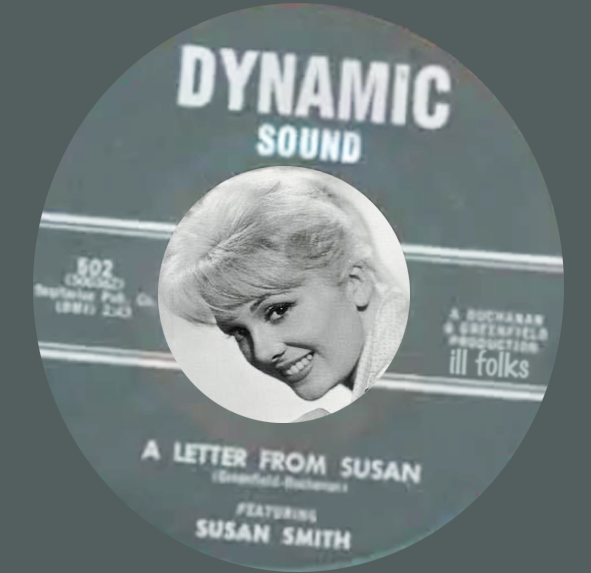
SUSAN SMITH - A LETTER FROM SUSAN - DICKIE GOODMAN’S WIFE BREAKS UP!


    Logic would tell you, “ah, Dickie Goodman’s wife was cajoled into doing a female narration for one of his dopey break-in novelty singles.” But in the world of Dickie Goodman, there is not a lot of logic. 

    First off, why would anyone change their name to something as bland as…SUSAN SMITH? That’s not too logical.  THEN we get to the amusement (almost as much fun as the record) of how this woman actually got a break in the comedy business from Dickie’s one-time partner Bill Buchanan instead. 


    According to the modest (the book IS full of typos, including the inability to spell Leiber or Stoller) tome authored by Dickie’s son Jon: 


    “My mother Susan Smith Goodman, was linked to Dickie Goodman by destiny before they even met. Her upbringing lead her to a singing career. And she recorded a break-in record, A LETTER FROM SUSAN (1962), with Dad’s former partner, Bill Buchanan. Bill Buchanan had acquired a new partner by then. Howie Greenfield was an established Brill Building music publisher…Ironically, this strange twist of fate wasn’t even what brought Susan to gaze into Dickie’s green eyes. It would be years before she met him and it wasn’t through these two artists…”

    “Mom’s father, Elliott Finkelstein, born August 19, 1902, grew up in Brooklyn. His parents were Russian Jew immigrants. Mom’s mother, Celia, was another Brooklyn born descendant of Russian Jew immigrants…on May 16, 1939, Esther Duchess Finkelstein (Mom) was born… (in) a pre WW II apartment building in Gravesend Brooklyn….Mom still lives in one of those buildings…paying rent…” 


    Esther Finkelstein, Esta as she was called, called herself by a less semitic name: Joan Elliott. Under this name, she appeared in road company musicals including “Damn Yankees” and “Pajama Game.” When this didn’t get her anywhere, she dyed her hair shiksa-blonde and took on the new name Susan Smith. She appeared on Broadway in “Bells are Ringing” and opened for Las Vegas singer Eddie Fisher among others. The Vegas beauty sometimes journeyed to California where shewon bit roles on a variety of TV shows, from “Dobie Gillis” to “Maverick” to “Perry Mason.”


    “A Letter from Susan” was atypical of what Susan Smith was all about, but she did seem to enjoy comedy, and hanging around comedians. Jackie Kannon, known to knock out a novelty single or two, had a stand-up club called The Ratfink Room. He even had a short-lived comedy/sex magazine by that name. It was there that Dickie Goodman glommed her and was smitten. We’ll leave it at that for this entry. Time for you to check out how a female does a “break-in.” 


A LETTER FROM SUSAN (break-in novelty) No dopey ego password, no pesty demand for a Paypal tip

SUSAN SMITH: BOY! Is there anybody going to listen to her story?


    The story of Susan Smith Goodman continues with…the a cover of the Lennon-McCartney classic, "GIRL."   

    As mentioned in the previous post, Susan Smith met her second husband Dickie Goodman at Jackie Kannon's club, The Ratfink Room. Jackie was signed to Roulette (home to Jimmie Rodgers, Tommy James, and Joey "Peppermint Twist" Dee) so Susan got a deal, too. It made more sense to be on a label with some well known names than try and put out a serious song on a novelty indie label.


     As Jackie Kannon knew, being signed to a "major label" had prestige, even if it didn't give royalties or lead to a Top 40 hit. Susan's "BOY," didn't go anywhere, but she went everywhere. The "major label" recording artist opened for Vegas stars and performed in nightclubs. “Susan Smith has the eyes of Kim Novak, a torso that commands attention, and a winning personality,” raved a review in the New York Herald. 

    “Boy” is a nice enough cover of “Girl,” isn’t it? The flip side was “I Won’t Turn Away Now.” Another Roulette single, which could be the title of a tome on Roulette's sneaky bookkeeping lies and misdemeanors: “The Cupboard’s Bare.”   


    After Roulette failed to do her justice, Dickie Goodman, now exploring more serious music styles via commercials and rock bands, tried to help Susan get that elusive hit. In 1967, they released a single called “Sunshine Days” b/w “Congressional Medal of Honor,” about Vietnam. He had other ideas for her, too. According to their son Jon, “Dickie’s connections got Susan a stellar opportunity to audition for singing the theme song to the movie “Valley of the Dolls.” But another young hopeful was given the role instead, Dionne Warwick…the studios were pushing new black performers at the time.”


    One of Goodman's better known projects was “The Glass Bottle,” a rock group born out of a promotion idea for selling recyclable glass over plastic. Around the same time, 1969, his wife was renamed "SUSANNA" Smith, and another single appeared, “Sarah Jane” b/w “St. Marks and Third” (a reference to where they picked up their older daughter from school). A semi-psych piece that started softly and then got more dramatic, it may have started too mildly to get the attention of busy disc jockeys and reviewers who gave an unknown maybe 10 seconds to wow 'em.

     Susan Smith may not have been too disappointed. She'd been kicking around show biz a long time, and now had two kids to raise. The Goodmans lived on East End Avenue, near Gracie Mansion and the East River, a neighborhood so tony, guys named Tony didn’t live there. Unfortunately wildman Dickie gambled his money away, and philandered on his pretty wife. He began to brazenly record with his mistress “Ruthie.” Her name was on a single…which led Susan Smith to become single. She filed for divorce. She got the apartment, but she gave up show biz to try and keep paying the rent, and raising her kids. 

    Son Jon again: “Let’s face it, you don’t go into a relationship thinking, I’ll marry this person, we’ll bring children into the world and then we’ll destroy each other and live out the rest of our lives in squalor…She could have had any man she wanted and all the good ones were taken.” 

     For more information on how the story unfolded for Susan and Dickie, get Jon’s book, which, amazingly, he doesn’t give away as a free download on a blog. Sadly, Susan’s collected works have yet to make it to a full-length tribute CD. It’s probably a combo of not being able to find good masters on some of her indie works and not owning the rights to the few major label things she did. Oh yes, and one other thing: who buys CDs? In fact, who buys music unless it's by Kanye or Taylor? People prefer to stream off a juke-box like YouTube or the low-paying royalty-challenged Spotify. If they own, it's because somebody offered a free download. Oh…BOY....

BOY - Beatles cover by Susan Smith - instant download, listen on line. No creepy German or Iron Curtain server loaded with spyware and porn ads

KATE SMITH - the THANK YOU song (you're SO welcome)


     Every now and then you need a lecturing reminder of how GRATEFUL you should be for what you have. This could be "You Have No Right to Be Sad," by PhD (on this blog somewhere) or even "Count Your Blessings (instead of sheep)" by Eddie Fisher (not on this blog anywhere.) 

      Be thankful, for example, that you didn't buy "Songs of the Now Generation" by Kate Smith. 

    When sappy big band songs went out of favor, Kate’s label suggested she simply sing sappy pop songs. You know, shit like “Little Green Apples.” Seriously. Little green apples WILL give you the shits. Why sing about them? And don't add "Honey."

    She put out a few albums that dragged Beatles songs and others into the middle of the road.  She didn’t get much of a “thank you” for this. Her old fans were not ‘In the Mood’ and young fans actually LIKED the Beatles and didn’t need grandma enunciating the lyrics. Maybe Mrs. Miller fracturing them, but not Kate doin’ it straight. 


    While Kate's game takes on Jimmy Webb ("Didn't We" and "By the Time I Get to Phoenix") might get gales of laughter at some gay party where the laughing gas goes in one end and out the other, they really aren't worth posting to normal people.  Out of curiosity, a Beatles track did appear on the blog last month. However...in actually re-listening to Kate's album, no question, “The Thank You Song” is a curio worth a listen. 


    It sounds like a kiddie record, not something that belongs between Bacharach and The Beatles. Music scholars might nestle this nugget between such horrors as "The Children's Marching Song" (aka "Nick Nack Paddy Whack" or "This Old Man") and the worst of show tune advice songs ("Whistle A Happy Tune"). The latter would be the right track. "The Thank You Song" was performed in "Maggie Flynn," a short-lived musical that starred Shirley Jones and Jack Cassidy. The book and lyrics were from Hugo and Luigi (Hugo Peretti and Luigi Creatore) and George Weiss (yes, the same team credited with souping up "Wimoweh" into "The Lion Sleeps Tonight.")


     Yes, there IS a good reason why this blog’s links do NOT have “ENJOY!” or “DIG IT!” on the link. Maybe "BEWARE" would be more like it. "The Thank You Song" is something you have to experience, like licorice chewing gum. 

You don't have to leave a nice comment over THE THANK YOU SONG

LORNE GREENE - SOMETHING’S GOTTA GIVE + Gene Barry "Burke's Law"


     One of the preoccupations with campy gays, and jealous nerds, is making fun of celebrities who sing. As in: how DARE they? As Shatner sang, in his great “Has Been” song, it’s “The never was talking about still trying…Forever bitter gossiping about never say die.” 


    Which isn’t to say that Lorne Greene wasn’t being risky when he switched from narration (“Ringo”) to handle swingin’ jazz. Greene, like another Jewish leading man, Gene Barry, had a very distinctive voice. Gene put out a solo album and even starred in a stage musical or two. He and Lorne figured an actor’s voice, trained for inflection, could handle mere musical notes. Lorne and Gene could carry tunes without dropping the key. 


    At worst (and there are those "golden throats, worst of celebrities singing" CDs) you get to hear what these people sound like in the shower. If you're a fan, you're not going to be too disappointed. With very few exceptions, the stars, the managers and the record labels haven't put out roaringly "so bad it's good" stuff. You have to be one hell of a pathetic loser to force laughter through your Chapstik-coated lips because Lorne Greene's just a tad creepy about swingin' the jazz.  


   As for Gene Barry, if you remember "Burke's Law," then you know he was always fond of singing, and a few episodes gave him the chance to carry a tune. He was always musical, studying violin in his early days, and getting a scholarship to the Chatham Square School of Music on the basis of his singing. His first Broadway appearances were in operetta (Rosalinda in 1942, The Merry Widow in 1943) and of course he returned to Broadway 40 years later for La Cage aux Folles.  


    Even so, some may cringe slightly as the former Eugene Klass uses his New Yawk accent ("Hey, Luvvah.....") to croon the hacky lyrics ("...let's make the scene") grafted onto the "Burke's Law" theme song. But....hilariously awful? Only to people who dress in drag to look hilariously awful. 


LORNE GREENE - instant download or listen on line. NO Paypal Tip wheedling, no ego-asshole passwords

BURKE'S LAW THEME BY GENE BARRY

Wednesday, August 29, 2018

KATE vs McCARTNEY - The Beatles weren't easy listening and didn't enunciate


A very queer musical term is: “easy listening.” 

    What is so difficult about music? Few things are EASIER than listening to music. You don’t have to do anything. As anyone who has suffered a bad train ride, an irritating visit to a shopping mall, or moronic neighbors know, it’s TOO easy to listen to music. The HARD part is shutting it out! 


    Years ago, snowflakes unable to tolerate voices, bought Mantovani “instrumentals,” accent on “mentals.” The idea was to "easy listening." Like having thicker white bread for your sandwich, because you don't want to taste the meat. Or adding few extra spoonfuls of sugar in your coffee and maybe fill half the cup with cream. Mmmm, good. Let's not actually taste the coffee too much. Lack of taste can be a taste. So say the fans of James Last and Ray Coniff and the rest. 


     You might think "easy listening" is now out of style. After all, Kate Smith is dead. But we do have Adele. She's made a fortune by appealing to all the saps in the trees. There are bloggers who still weep and sigh and post Acker Bilk stuff, and figure Andy Williams' take on "Bridge Over Troubled Water" was the definitive one. Contemporary pop and jazz vocalists continue to cover rock songs THE RIGHT WAY, and unlike Pat Boone doing heavy metal, there's absolutely no sense of humor behind it.  

    When “Here, There and Everywhere” came out, young rock fans figured their parents MIGHT not object to The Beatles if they heard this lovely, simple ballad. But, no…STILL not “easy listening” enough. They had to hear it from an "easy listening" vocalist, or somebody who knew how to enunciate clearly, like Kate.


Kate Smith was so fat she was HERE THERE AND EVERYWHERE - no ego password, no snotty demand for Paypal money, no download server sending you to bogus porn sites or trying to malware you

KATE vs CAT -- was the Kate Bush really...definitive?


    You all know Kate Bush’s version of her song “Babooshka.” Too screamy. Too dramatic. You want to know how it should be sung? Cool. That’s how. Restrained. Sophisticated. Done in the style of a chanteuse in an expensive French bistro that specializes in JAZZ.


    Right? Jazz and easy listening fans would think so.


    As Billy Joel once pointed out, we all have a “pointless point of view,” and it extends to music. We think what we like is right. Some old white European will tell you Beethoven’s music is REAL MUSIC. Some young black African is proud of banging on a drum and clapping the discs in her mouth together for some added clack. According to Rolling Stone, the most popular music now is RAP. That means it's art, too.


    Some brag that the REAL DEAL is the soul music they like (whites need not even TRY to sing it), or hardcore Hank Williams country music, or Miles blowin’ a riff on his horn. Genre music fans are often insistent that their outsider music is in. Meanwhile Adele and Taylor Swift fans tell you to go with the mob and stop calling that stuff crap.


    You remember when the Hollyridge Strings, Sinatra and Aretha all gave you the RIGHT way to listen to Beatles songs?  


    Most would say the artist has the definitive take, and most cover versions are way off. Then there's the easy listening bunch who say "tone it down," and the jazz crowd who say "that's not cool if you don't croon it." 


    Jazz singers sure wanna SMOOTH that rock! Right, Cat-Ballou? 


BABOOSHKA - listen online or download - no dopey passwords, no "tip jar" Paypal whining, no slimy servers that give you spyware and trick you into downloading a NEW version of Adobe

Thursday, August 09, 2018

Charlotte Rae passed away on August 5th. She was 92. A "sick" MERRY MINUET


      First off, in offering a picture of Charlotte in her TV sitcom prime, the full cover of her obscure album was cut off a bit. The title is NOT, "Songs I Taught my Moth." 

    Sad that the lovely, talented and naturally funny Charlotte Rae is no longer with us.  Also sad is that the representative song below is not up to the usual blog-basic standards. The one time I saw it, in one of the used record shops I used to haunt, the jacket was split on most of its seams and the previous owner had played the vinyl a lot. Fortunately with some careful digital work, the sound quality picks up after some unavoidable crunchiness during the first 20 seconds. Another problem is that back then (around 1955) some records were pressed “quietly,” and you had to turn up the volume just to hear it at all, thus magnifying any dust or scratches.

    When the obits arrived on Charlotte Rae Lubotsky, almost all of them concentrated on her mature work as a sitcom star. That would be “Diff’rent Strokes,” which evolved into “The Facts of Life.”  There was some mention that she played Mrs. Schnauzer on “Car 54 Where Are You,” but you’d have to be OLD to remember or care about that show. (Remembering and caring being two different things). 


    Charlotte was atypical of most Jewish entertainers; she was born in Wisconsin and attended Northwestern University. She didn’t come to New York City till 1948. It took a half-dozen years for her to establish herself, as she worked the posh nightclubs (Blue Angel, Village Vanguard) with comedy routines and parody songs (including a Zsa Zsa Gabor imitation, courtesy of songwriter Sheldon Harnick).  


    She managed to snag a role in the obscure musical "Three Wishes for Jamie" in 1952, and got good notices for “The Threepenny Opera” in 1954. The following year she turned up in "The Golden Apple," and parlayed her credits into a record deal. Her first and last album is a rather fey and chi-chi collection of sophisticated songs. Frankly, it's dated now, and the stylings would seem pretentious to anyone who doesn't know and like some of Rae's contemporaries: Cole Porter (she covers two of his songs), Noel Coward, Hildegarde, Anna Russell and Elsa Lanchester. Rae's stand-up style was like Jean Carroll's, without the neurotic quavery voice that she (and Alice Ghostley) would find so lucrative in TV sitcom work. 

    “Merry Minuet,” one of four Sheldon Harnick songs on the album (which is, amazingly, now on CD) was first sung by Orson Bean in John Murray Anderson’s revue “Almanac.” Revues were all the rage back then, with Leonard Sillman creating his annual “New Faces” variety show (Rae was in one of those), Ben Bagley offering his “Shoestring” revues (Rae was in one of those, titled "Littlest Revue") and Julius Monk selecting promising stars for his “Upstairs at the Downstairs” shows. Harnick would go on to write the lyrics for “Fiddler on the Roof,” including one of the most charmingly cynical songs in Broadway history, “When Messiah Comes.” How cynical does it get…the song was funny, cutting, and cut from the show before the curtain rose. (When Herschel Bernardi replaced Zero Mostel as Tevye, and issued his own album of “Fiddler” songs, he made sure to cover “When Messiah Comes.”) 


    If the name “Merry Minuet” sounds familiar, it’s probably because of the Kingston Trio version, which hammered the song into folk, and accentuated the Tom Lehrer-like ghoulishness of cheerfully acknowledging world chaos. 


    Here, Rae performs it very much in cabaret style, with the so-called “Baroque Bearcats” helping out, and John Strauss at the piano. Strauss and Rae were married in 1951. Although she worked TV (since so many variety shows were shot in New York) she preferred Broadway. This included her very atypical turn as “Mammy Yokum” in the original stage production of “Li’l Abner,” her co-star role with Ghostley in "The Beauty Part," and her Tony nomination opposite Harry Secombe in the failed musical "Pickwick." She ended the 60's with her second Tony nomination for "Morning Noon and Night." She was in "Boom Boom Room" with Madeline Kahn in 1973, and won an off-Broadway Obie for "Whiskey," written by Terrence McNally.


     She moved out to California for TV work, including a memorable guest spot as a neurotic, emotional Tupperware saleslady in "All in the Family." From there, producer Norman Lear cast her in “Diff’rent Strokes,” and the spinoff "The Facts of Life" where her character Mrs. Garrett was housemother in a school for girls. The 70’s was a time for explosive new freedoms, from stage nudity to edgy political comedy. People were encouraged to be themselves, and husband John Strauss came out of the closet and told Charlotte that he was really gay. Now was the time for him to realize who he really was, and be a happy gay. It was time for Charlotte to get a divorce.

    "The Facts of Life" helped Charlotte Rae achieve fame and economic security. It might not buy health, but it allowed her to keep on top of emerging problems, and she beat pancreatic cancer and had a pacemaker installed in 1982. She left her sitcom due to the strain of the work (Cloris Leachman, her friend from Northwestern University became the new housemother) but she took roles at her leisure. This included the challenge of a Chicago stage production of “Driving Miss Daisy.” She wrote her autobiography and was still in demand for interviews and other work when was diagnosed with bone cancer last year. The fact is...she had a very full life. Her autobiography will tell you much more. 


 The wry, doom-loving MERRY MINUET by Sheldon Harnick, performed by Charlotte Rae

Lesley Duncan, born August 12th


It's a strange situation, where we can thank the Japanese for preserving the work of British and American singer-songwriters. If you want some of Lesley Duncan's albums, or Bobby Cole on Concentric or Craig Doerge on Columbia or Severin Browne on Motown...you might find cheap used vinyl but if you want state of the art digital...it's Japanese CDs only. No other choice.

It's been said, and it's accurate, that the Japanese not only have a greater respect for some of our music than we do, but they also have better technology. If you check a Japanese import of the average rock album against the re-issue from an outfit like Collectors Choice, there's no comparison. But, unfortunately for the artists and their legacy, the average asshole not only thinks mp3 is good enough, but will happily "share" entire albums and discographies, to the point where re-issue labels can't even break even and only "eccentrics" support the high price of Japanese imports.

I didn't envision a future like this, when I was getting promo copies of albums and reviewing and promoting them. "Maybe Its Lost" was the first Lesley Duncan album that came my way, although she'd been having successes for many years. Oddly enough, though she wrote some great songs ("Love" was her song, the only song on "Tumbleweed Connection" NOT penned by Taupin-John) it was one of her covers that impressed me most on "Maybe It's Lost." It's Walk in the Sea" by Alan Hull.

Hull (February 20, 1945-November 17, 1995) like Ken Kesey, allegedly wrote his best material on LSD, including "Clear White Light," "Fog on the Tyne," and "Lady Eleanor," the latter apparently inspired by his love of Edgar A. Poe the author of "Eleanora." His "We Can Swing Together" was a big hit for his group Lindisfarne, which was a very big-selling group circa 1972. 

Lesley Duncan (August 12, 1943-March 12, 2010) died at 66 after struggling with cerebrovascular disease.

Sometimes called "the British Carole King," she was one of the few female singer/songwriters from England back in the 70's. It was tough for her getting started, because when she began she didn't fit the mold of a Petula Clark or Cilla Black: “You had to be glamorous and pretty and I just couldn't play that role, I found it absolutely impossible. You'd be the token pretty girl and I just couldn't be that. I didn't even try; I'd have just felt a total phony. But I've been at odds with the business all along, starting very early. I always felt uncomfortable with lots of aspects of show business. I think they found people like me a little hard to handle, 'cos I was rebelling already - whereas I think they were very sure of what to do with the more compliant ones, like the Susan Maughans, who were happy to play the game, to play the glamorous dolly-bird, do the TV shows and the cabaret.”

“And also, because there weren't that many girl singer/songwriters around at the time, there was nowhere to put me comfortably. Lots of girl artists, but not many who were writers too and so it was a bit uncomfortable for me because I had no-one helping me out, as it were. It has come a long way, but I think I was one of the forerunners….I was one of the early ones blazing a trail, if you like."

She dropped out of school and took the usual miserable waitress-type jobs while trying to sell her songs. Though she managed to get face time in the movie "What a Crazy World" (1963), she remained mostly behind the scenes, waiting for one of her songs to be a hit for somebody else.

She sang back-up for Dusty Springfield, then got a big break as a performer via her Elton John duet on "Love Song." The following year finally released her first album "Sing Children Sing" in 1971. She also appeared on Pink Floyd's "Dark Side of the Moon" and sang "If I Could Change Your Mind" on the Alan Parson album "Eve." She was a backign vocalist for Elton's pal Kiki Dee and many others, but her solo career stalled by 1974's prophetic "Everything Changes," and her last album, in 1977, was "Maybe It's Lost."

Fortunately, the demise of her career as a viable singer/songwriter was the beginning of her successful marriage to record producer Tony Cox in 1978 (her two sons were from a previous marriage). One of her last recordings was a version of Bob Dylan's "Masters of War" circa 1982. Her disappearance from the music scene was a combination of family interests and physical problems. She said some years ago, "I've been fairly quiet musically for various reasons. One is that I can't seem to think straight with two teenage sons around me!

"I've built up a little stockpile of tracks again, though. It's a bit like a repeat of the 60s, where I've had a lull, and I'm gradually compiling a little dossier again. I've got about three or four recorded now...I'm beginning to recover energy and thinking maybe I'd like to do that. But it's hard, because as I've told you, I don't really care much for the business and I don't want to go out and sing, so I suppose it's unfair to expect a record company to invest a lot of money letting you make an album if you're not prepared to go out and promote it - which I'm not, that life is just not for me."

Walk in the Sea: Lesley Duncan

Elvis Costello’s Dad Ross McManus “Patsy Girl” - this Guyana’s In Love with You


      For a little while, Ross McManus was "Mr. Patsy Girl," the guy who hit the charts his first time out. "Patsy Girl" was credit to Ross McManus and the Joe Loss Blue Beats. The HMV single (1964) was the solo vinyl debut for a guy already respected as the vocalist for Loss's very popular big band.

       Born Ronald Patrick Ross McManus (October 20, 1927-November 24, 2011), he was both a singer and  trumpet player for Joe Loss. He took his son Declan McManus (Elvis Costello, born in 1954) to some of his gigs and TV tapings. The kid was delighted to meet all kinds of famous musicians thanks to his Dad and the fame of the Joe Loss group. At the height of Beatlemania, his Dad came home one day with...yes...ALL FOUR BEATLES AUTOGRAPHS. Because the large piece of paper couldn’t fit in his autograph book, ELvis cut each signature out individually to preserve.

      Elvis' Dad was an expert musician who could almost instantly memorize any song. He'd slap a tune on the turntable, get it down, and hand off the vinyl to his son. With budget cover version records becoming popular, Ross moonlighted as a mimic, covering a diverse range of artists. For cheap labels such as ROCKET and CANNON, Ross would come into the studio and knock off a bunch of tracks using different voices. He used different names, too. As Hal Prince, he performed Roy Orbison's "It's Over." As Frank Bacon (backed by the Baconeers!) he sang The Beatles "She Loves You." Ross was the lead voice behind mythical groups such as The Layabouts, The Ravers and The Foresters, the latter specializing in folk music. 

       Ross's background in voices was an asset when his first single came out: a novelty A-side done in a Guyanese accent, backed with a jivey variation on Muhammad Ali (see I'm the Greatest" below).

    Pretending to be “of color” is not PC anymore, but there was quite an arc for it, starting with the minstrels and Al Jolson, and wandering through “isn’t he a black guy?” 78 rpm singles by jazz vocalists Frankie Laine and Louis Prima. In 1964, it was ok to goof around with an accent, and "Patsy Girl" did well. Singing ethnic would remain with us through Sting’s ridiculous “Roxanne” and Peter Gabriel’s offensive “Biko,” which can’t pay tribute to an African without mimicking the dialect. 

    In 1964, did people assume Ross McManus was from Guyana? Did they simply think he was a white guy putting on an accent the way Lonnie Donegan fucked around with hillbilly American voices? Most likely people just weren't as fucked up as they are now, and figured that if somebody wanted to cosplay in another dialect, it was a tribute.

     Ross issued one more HMV single, "Stop Your Playing Around" in 1966, and was signed by Decca for a one-off, a cover of Frankie Valli's "Can't Take My Eyes Off Of You." His next and last single, on the Spark label, was a Beatles cover, "The Long and Winding Road" issued under a new name...Day Costello. Altogether now...the DAY would come when another Costello would get a chance at the charts...and come up with hit after hit.

PATSY GIRL - a hit for ROSS MCMANUS listen online or download. No ego type-my-name passwords, no "give me a Paypal tip for my HARD WORK" horse shit.


"I'm the Greatest" - Elvis Costello? No, His Dad Ross McManus as MUHAMMAD ALI


    Back when he was Cassius Clay, and not yet the World’s Champ, Muhammad Ali and Columbia records offered both a single and an album, “I am the Greatest.” He wasn't competing with Joe Frazier as a singer yet. (Not yet; he eventually tried singing via a cover version of “Stand By Me”) On the record and the single, Mr. Clay recited his comic poetry. 

    Clay’s “I am the Greatest” is not covered by Ross McManus, Elvis Costello’s father. This is a completely different tune. The novelty B-side to the novelty “Patsy Girl,” it offers a pretty ok impression of the brash new boxing star. There might be a little too much Ray “Harry the Hairy Ape” Stevens in there, but it’s ok. The number is very much a Louis Jordan-type bop boogie. 


     Perhaps trying to steer clear of a lawsuit, the lyrics don't specifically mention boxing. It's just a coincidence that the singer reference's Drew “Bundini” Brown’s catch-phrase for his pal Ali: “Float like a butterfly sting like a bee,” by doing a bee sting gag. Anyone without a knowledge of the boxing scene (in 1964) or the catch-phrase "I am the Greatest" might just think the song is simplyi about some guy coming on to his girlfriend. 

    This single probably turned up in stores after Clay won the championship from Sonny Liston (February 25, 1964) and announced he was now Muhammad Ali, one of the dreaded Black Muslims.


     Back then, Elijah Muhammad (Ali's spiritual leader) and Malcolm X both spoke angrily about whites (Malcolm being the “blue eyed white devil” guy). Ali was outspoken in favor of segregation, and said he didn't have anything against whites but didn't think it was a great idea for the two races to mingle that much. He was the opposite of Jack Johnson when it came to white women. His wives (he eventually had four, and eight children including a few out of wedlock) all had to be Muslim. He would sign autographs on booklets about Islam so that fans might read and convert.

      Many people, especially "youngsters" (as Ed Sullivan used to say) loved Cassius Clay and his comical brashness. The elders weren't so amused, and many were hoping Sonny Liston would shut his mouth. Or Henry Cooper. Or Floyd Patterson. Or Joe Frazier. Clay played off his loudmouth publicity, intentionally being the showman. He'd been inspired by Gorgeous George, a wrestler whose fame and money rested from being prettier and more flamboyant than the others. As Clay, he even did a photo op with the brash Beatles in Florida. He had no idea who they were, just that it was good publicity. After the "moptops" left, he mused, "who are those faggots?" 

      Becoming a Muslim seriously alarmed people, because that cult seemed dangerous, and some of its leaders, particularly Malcolm X, were spouting a lot of violent and reverse-racist views. Some of Malcolm's speeches were loaded with anti-white, anti-Semitic, and totally nuts re-writes of religious history, portraying Islam as older than Christianity and Judaism. Some of the teachings involved even more bizarre fairy tales than Noah's ark or Adam and Eve. It was only after the deaths of both Elijah and Malcolm that a calmer version of Black Islam evolved. 

      Ali's refusal to be drafted for Vietnam, even if given a cushy job entertaining the troops or being a conscientious objector, led more people to dislike him. He remained a favorite of the younger generation, and of those who reasoned that a guy who could goof with white Howard Cosell, and be trained by white Angelo Dundee, and have white Ferdie Pacheco as his ring doctor, was not racist at all. Over the years, many came around to admiring and even loving Muhammad Ali. He overcame his losses (to Frazier and Norton) and found a way of beating George Foreman against all odds and advancing age. 

      He retained his good humor, and his genuine love of all people could be seen in the way he found time to play with children, do magic tricks, comfort the elderly, and be patient and gentle with the mobs that followed him all over the world. Amazingly, he didn't turn away visitors who came to his Michigan home to say hello or get an autograph, and he also made sure his training camp was open so fans could stop by. This frustrated his wife and his managers and trainers, but it was the way he was; he genuinely respected and empathized with everyone, and unlike Joe DiMaggio and so many other big-named stars, he felt an obligation to brighten the day of the average person, and make a wish come true for those who wanted to shake his hand. 

       He had everyone's sympathy when his health began to fade, and the voice that had brought good will to the world, and good humor to so many, was stilled. He retained his dignity, even with the immobile face and trembling hands, and didn't stop making public appearances. When the 9/11 terrorists and subsequent attacks tarnished the name of Islam, Muhammad Ali issued a statement making it clear that his was a religion of peace, and the Muslims involved were dangerously misguided. Ali prayed five times a day and read his Koran. 

        Meanwhile, back at the download...Whether Ali ever heard “I’m the Greatest” or thought it was funny…nobody seems to know. 


"I'm the Greatest" - Ross McManus instant download, listen online, no passwords or creepy foreign language spyware site to go to

Elvis Costello's Dad does the DC5 - BACON BITS!


You may well ask, "Why is there no mention of DC's actual name here?" 

Because DC is a bit of a git, and he keeps a tight control of his catalog. He always kept tight control over his band, too, and there were complaints about who got the big share of the money. Rightly, he's one of the people rich enough to file complaints when things get beyond "fair use," as they usually do with blogs, forums and torrents. He might figure this is "fair use" but...sometimes people hire BOTS as part of enforcement, and a BOT has no idea and doesn't make value judgments...just automatic bonking. But a name in a photo? Nudge nudge, wink wink, say no more.

Now then. Elvis Costello's father was very successful performing live with the Joe Loss band, touring all over Europe. He was somewhat successful under his real name, issuing a few singles. Well, very few. Three between 1964-1967. He was also in demand as a "cover version" singer, somebody who could sound like a high-priced star. You might recall the game that Promenade and other labels played, of offering THREE songs on each side of a 45 rpm single, allowing pre-piracy music fans the option of hearing their favorite songs six for the price of one. Just not by the original artist. 

As "Frank Bacon," Ross did his best to replicate the DC5 sound. Listen....

BITS & PIECES of Bacon. Actually, the whole song. Listen or download. NO obnoxious Paypal tip-jar request.

DO YOU LOVE ME Bacon version? Don't shrivel away. Download or listen online. No passwords or bullshit "your flash is out of date, DL some spyware" warning

ROE YOUR BOAT: HEY "EVERYBODY" IT'S REALLY COSTELLO'S DAD!


No, that's not Buddy Hackett opening for Elvis Costello. 

Elvis enjoyed paying tribute to his Dad. When a geezer came up to Elvis and said, "Yer not the singer yer father was," Elvis smiled and agreed. 

Ross McManus was certainly a fine big band singer when he was with Joe Loss, but also, a very versatile one. He could sing in a lot of different styles. He was sought after for a lot of lucrative if anonymous work. 

When he died in 2011, some of the obits headlined: "Elvis Costello's Father: Secret Lemonade Drinker." What?

The last part refers to a very popular ad on British TV. It ran from about 1973 to 1981, which could've meant that while Elvis Costello was having a hit with "Alison," his Dad was actually reaching more listeners! 

The singing voice for the pyjama (we're talking England) clad secret lemonade drinker (Julian Chagrin) was Ross's. The odd thing is that Julian doesn't look that far removed from Elvis Costello, or, of course, a young Ross McManus. Connoisseurs of this idiot commercial have noted all the variations on how the guy walks downstairs at night (hushing his curious dog), gets all excited about having a bottle of R. White's, and then gets caught by his wife. There were several different wives including the old comedy legend Frankie Howerd. 


EVERYBODY seemed to have a reason to know and appreciate Ross McManus. This includes Tommy Roe? Well, maybe not. Back in the days of copycat cover versions, McManus used yet another alias for his version of "Everybody" in 1966. Here's "Hal Prince" singing the Tommy Roe song...

EVERYBODY -- download or listen online. No dopey passwords, no creepy German or Russian server or malware


Sunday, July 29, 2018

"SUGARFOOT" - TV THEME with LYRICS - Good Will Hutchins


Here's a shout-out to Will Hutchins, who is now 88. It's taken a while, but his legendary series "Sugarfoot" is now out via legit box sets. These sets are "print on demand," meaning they're a little more expensive on eBay than some other TV season sets. We're fortunate they exist at all, since piracy has led many companies to simply forget about releasing stuff that's "all over YouTube and blogs and torrents and hidden forums." Since everybody likes "free," it's up to fans to step up and buy, and cut out the "my old man's a Dutchman" snickering excuse for "sharing." While Uncle Putin leads some to think that Capitalism is a bad idea, buying and selling is important, and the only way that the studios will offer us pristine digital quality re-issues, or even bother to go into their vaults at all.

Funny thing, Will had a perfect real first name for a western hero: Marshall. He was born Marshall Lowell Hutchason. He was born as far West as you could get at the time: California. His first movie role was as an extra in the W.C. Fields comedy "Never Give a Sucker an Even Break." 

Born at the right time, he was in his 20's when a talent scout at Warner Bros., hungry for handsome guys to star in their burgeoning collection of westerns, signed him up. The same thing happened to James "Maverick" Garner and many others. In the case of the newly re-named Will Hutchins, the slant was to cast him as a brainy version of a western hero. Why not? Will was a cryptographer during the Korean War.

As Tom Brewster, he was the "Sugarfoot," a greenhorn who wandered the territory getting into problem situations and hoping to get out of them with reason and logic...and a knowledge of the Good Book and law books. Brewster, you see was studying to become a lawyer. In fact, he could defend somebody better than shoot somebody. Of course on "Greenhorn," that show about a sugarfoot...oh...my error...things could reverse. Not THAT often though, because Warner Bros. had plenty of other cowboys who were brawnier and quicker on the draw:


That's Will on the left. This is only SOME of the Warners stable (and there was also competition from other studios during the extreme era where DOZENS of westerns dominated prime time TV). 

Oh. You don't recognize all of the guys? It's Will, Peter Brown, Jack Kelly, Ty Hardin, James Garner, Wayde Preston and John Russell. I know, they missed Clint Walker, among many others. (Parenthetically, John Russell and Peter Brown's "Lawman," also finally on DVD or DVD-R, holds up excellently. Russell is even more intense than Clint Eastwood, and troubled Peggie Castle was an alluring saloon girl on the show.) 

"Sugarfoot" lasted for three long hot seasons (69 episodes in all) and they still hold up very well, thanks to Will's unique all-American personality. You'll also find all kinds of soon-to-be stars turning up in guest roles including Adam West, Charles Bronson and Martin Landau). All kinds of cult favorites turn up as well, including the oh-so-delightful Venetia Stevenson, consistently creepy Ray Danton, and "Plan 9" stalwart Gregory Walcott. This was, and is, a somewhat underrated show, and Hutchins was absolutely perfect as the idealistic young lawyer with a slight Will Rogers touch (not much, since it isn't easy to write Rogers-type one-liners). 

Will's versatility, post-"Sugarfoot," included everything from "Alfred Hitchcock Presents" and "Perry Mason" to the Elvis Presley film "Spinout" and "The Shooting" co-starring Jack Nicholson. He also starred in two short-lived sitcoms, "Hey Landlord" and "Blondie." The good-natured star was less active in the mean-spirited late 70's and 80's, when many nice-looking blond guys (Troy Donahue, Doug McClure, Tab Hunter) likewise had trouble finding suitable roles in middle-age. 

Fans of the classic westerns have been very loyal, and have supported various cowboy-themed memorabilia shows around the country. Will has always been known as one of the really "good guys," just like his "Sugarfoot" image, willing to listen to fanboy babble, and glad to personalize an autographed photo. 

While "Sugarfoot" remains one of the more original Warner Bros. western concoctions, in one way it was just like the rest: a stupid theme song. At best, the theme song simply and ridiculously explained the show's premise ("The Lawman came with the sun. There was a job to be done.") At worst, the lyrics had idiot repetition ("Riverboat ring your bell, fare thee well Annabelle") and things you could easily misunderstand (Maverick didn't live in Jackson Heights, Queens, he lived on Jacks and Queens, because he was a gambler.) As for "Sugarfoot," you get to hear all about the "easy lopin' cattle ropin'" Sugarfoot, thanks to, of all people, Lawrence Welk, his bubbly band, and his sappy vocalists....

SUGARFOOT TV THEME SONG (instant download or listen online...no passwords, Russian spyware or obnoxious demands for a Paypal tip)

Thursday, July 19, 2018

LESLEY GORE - "START THE PARTY AGAIN" (oops, this one stalled...)


    What happens when you mix another Lesley Gore “party” song with a dash of a Herman’s Hermits-type British invasion dance beat? You get a can’t miss item…that missed. In fact, “it did not chart.” 


      Why toss it here? Oh, just as a reminder that there's no such thing as a sure thing. 

       I was enjoying a bunch of Gore (no, not the SAW movies) when up came “Start the Party Again.” I thought, hmm, pretty catchy, but did this obvious sequel go anywhere? No, a quick check of the reference books confirmed.  


        From the borrowed beat of the Hermits to the familiar voice of Gore and the familiar word “PARTY,” there’s no reason why this thing couldn’t have been at least in the Top 20. But who knows. DJ’s had other things to play. Gore was momentarily played out…despite playing "Pussycat" opposite Julie Newmar's "Catwoman" on a two-part "Batman" show. (That's where the picture above is from).

       You remember Lesley? Just old enough to NOT interest a guy like Jerry Lee Lewis,  she recorded “It’s My Party. “ Producer Quincy Jones, who covered a wide range of musical styles, knew exactly what teen whites would go for, and this was a #1 mammoth hit. She instantly knocked off a sequel: “Judy’s Turn to Cry,” which burrowed into the Top 5. 1963 was her year, and it wasn’t even half over yet. In June, 1963, her two hits were part of an album cleverly titled, “I’ll Cry If I Want To.”


    Back then, kids couldn’t afford an entire album too easily, and there were no Croatian or Russian blogs and forums to throw the music around, so "I'll Cry If I Want To" didn't quite make the top 20. It was loaded with filler that played on the words “Party” and “Cry.” There was “Just Let Me Cry,” “Cry and You Cry Alone,” “The Party’s Over,” and “No More Tears Left to Cry.” 


      Gore explored new territory with “You Don’t Own Me,” which has become a feminist anthem over the years, but quickly returned to being the hapless victim with the Top Ten drama of 1964, “Maybe I Know.” But…by 1965 she was treading water with a “Golden Hits” package, and no single reaching the Top 10. Things were likewise grim in 1966, as Mercury pushed four singles and only one (“Young Love”) made it to #40.  “Treat Me Like a Lady” didn’t even crack the Top 100. The "Mersey Sound" and Liverpool beat continued to dominate the charts. No surprise then, that "Start the Party Again" tried for a bit of the "Something Tells Me I'm Into Something Good" Herman's Hermits style. 

           Happily for Lesley, in January of 1967 the Marvin Hamlisch minor-key “California Nights” brought her back to the Top 10. It was her only 1967 success, as the single “Brink of Disaster” got no further than #82. Her career as a pop star was over. Still, her tunes remained "golden oldies" and she eventually mounted a career in cabaret clubs and swanky lounge rooms, combining the old hits with newer, more mature material. The phrase "Let's get this party started" became a cliche used by boxing announcers, and "Start the Party Again" was the title of a CD compilation of her hits. 

    The party can start and end, any time. And sometimes, despite all the calculations and formulas saying “this is a surefire hit,” the party might not happen at all.


START THE PARTY AGAIN - American girl, Brit invasion beat - no passwords, Paypal tip requests or delays and extortion about buying a "premium account" for faster downloads. NO $$ going to the uploader for "hard work"

JEFF CHANDLER - what's a "LOVELY WAY TO SPEND AN EVENING"?


      Above, Jeff Chandler and his lady friend, Esther Williams. It's somewhat of an odd pose, as Esther spent most of her film career in a swim suit, and Jeff liked to crossdress. 

      Like so many Hollywood stars, Jeff was asked to cash in on his screen stardom by putting out a record. It didn't do too well, but it wasn't because he wasn't an adequate singer. There was just so much competition from, oh, guys like Sinatra. It also wasn't because fans were turned off to the rugged 6'4" star because they heard about his "drag" proclivities. That stuff was unknown until Esther published her autobiography in 1999.

      Williams, who once took LSD, said that her book was just another form of "therapy." She said "Cary (Grant) told me LSD was like instant psychiatry, and I was sorry the kids got ahold of it and made it a recreational drug." She was likewise told that writing an autobiography was good therapy, and so she vowed to be honest about her many failed relationships, both with men she married (like Fernando "You look Mahvelous" Lamas) and ones she didn't, like Chandler. Some Chandler fans either didn't believe her anecdotes about him having a huge selection of gowns and accessories, or felt she was destroying his good name just to sell books. As if many people knew who Chandler was in 1999. 

        Chandler is even more forgotten now. HOW forgotten? I was in a boxing forum, and somebody mentioned Jeff Chandler...the obscure (except to fight fans) bantamweight who had a pretty good run (32-2) in the early 80's. I countered with a photo of THE Jeff Chandler, in his iconic role in "Iron Man" (1951) and people were very surprised. They didn't know the film or him. 


    Born Ira Grossell (December 15, 1918 – June 17, 1961) Chandler changed his name to something less Jewish, and won early fame playing Cochise in "Broken Arrow" (1950). He was nominated for an Oscar, and was quickly cast in another quirky film, "Bird of Paradise" as a Polynesian. Then came "Iron Man," and various exotic epics including "Sign of the Pagan." Meanwhile, on radio, where he'd begun his career in both sitcoms and dramas, he turned up as himself, and often sang. In the mid 50's he even played Las Vegas. 

      In the late 50's, he ended his association with Universal by starring in "The Tattered Dress" and "The Man in the Shadow," which Esther Williams may have considered as apt title for a Chandler biography. His cross-dressing didn't seem to have been a factor in his divorce from his first wife, or his brief flings with Gloria De Haven and Ann Sheridan, but back then studios were powerful enough to quash detrimental stories about their stars, and few tabloids would print such things without photographic evidence. After Williams' book appeared, Jane Russell huffed, "I've never heard of such a thing. Cross-dressing is the last thing I would expect of Jeff. He was a sweet guy, definitely all man." Well, that's why there's the phrase "in the closet," even though most cross-dressers are heterosexuals and many look lousy in drag (J. Edgar Hoover anyone??) Williams had grumbled, "You're too big for polka dots," but Jeff countered that he thought he looked quite charming.

       Chandler finished "Merrill's Marauders," another manly exercise, but entered a hospital to take care of a back injury, technically a spinal disc herniation, which was no longer responding to painkillers. As Brother Theodore once said, "the bad hospitals let you die, and the good hospitals kill you." Jeff Chandler went to a good hospital. Complications from the first surgery led to a second operation, which went on for seven hours. A third operation ten days later, and Chandler passed the crisis. He died. His children won a 1.5 million malpractice suit. Jeff was only 42. 

       And what's your lovely way of spending an evening? Take a few minutes to listen to Jeff Chandler sing....

Jeff Chandler - LOVELY WAY TO SPEND AN EVENING - listen online or download from a legit no-spyware server; no Putinville weasel clouds here

Say hello to TOODLE LOO from Berry Gordy's brother BOB KAYLI


     Here's a pretty silly ballad...a guy mewling "Toodle Loo" to his baby. You might even laugh, especially since it's from Bob Kayli, whose only chart action was in the novelty field. 

    The first thing you might want to know, if you have an inquiring mind, is where the idiotic expression “toodle loo” came from. The answer is…nobody’s quite sure. Some say it’s mis-heard from the French “a tout a lheure” (see you later). If you pronounce it “tootle-lure” and shorten it to “tootle loo,” you’ve got it. Maybe. It might be a mutation on the word "toddle." As in, “I’ll be toddling off to that new Indian restaurant…” “And toddles to you, too…” “Toodle loo…” Toora loora loora and a vindaloo, too. 


     Bob Kayli used a pseudonym rather than be identified as Bob Gordy, brother of Berry Gordy. After all, the song was on the Gordy label, and DJ’s of the day were a bit concerned about payola and nepotism. In the photo above, that's Robert on the left, Mable John, and Berry. Bob celebrated a birthday a few days ago (July 15, 1931) so what better way to celebrate a forgettable artist than to publish a forgettable song on an obscure blog? 
  
     Though Kayli gave a toodle-loo to his singing career, after only a few singles, he did have an auspicious beginning. His lone scrape at the Top 100 came in 1958 when “Everyone Was There” (written by both of the Gordy brothers) hit #96. Since the song was far from the Gordy label's soul stuff, it ended up being released on Carlton, which was more novelty oriented; they had a hit with “Little Space Girl.” That one featured a white guy with a black-sounding name (Jesse Lee Turner) while “Everyone Was There” had a singer’s name that seemed white (Bob Kayli) and a vocal style that was a bit similar in hiccups to Buddy Holly. 

     Sort of a name-dropping version of “Splish Splash,” Bob sings about a party…that featured all the hip novelty acts of the day:  


    “The Witch Doctor walla-walla’d in the sand while the Purple People Eater ran a hot dog stand. Everyone was there-eh-eh-errre, everyone but you-ha-hoo….then I met the pretty Pe-he-heggy Sue…”  

    Between 1958 and 1962 Kayli tried and tried again to get further into the Top 100. One novelty attempt was a COVER of an ANSWER song. Following “Big Bad John,” Phil McLean recorded the oh-so-clever “Small Sad Sam,” and Bob Kayli covered it. There's more curious-but-who-really-cares trivia for you. 


      “Toodle Loo,” which Kayli wrote by himself (the label credits R. Gordy) was the flip-side to “Hold On Pearl” (1962) which was another Bob and Berry co-write. “Hold on Pearl” is a stupid novelty that somehow mashes together the “Teen Horror” songs of the day (like “Tell Laura I Love her”) and the hapless soul miseries of a guy like Gene McDaniel (“Tower of Strength”). 

    The song didn’t go anywhere with its various stanza anecdotes about Pearl getting into trouble and Bobby having to save her: “She was laggin’ back and caught her size ten foot in a railroad track. The train was coming it was plain to see. She kept laughin’ at the train and screamin’ to me! I cried, “Hold on Pearl! Hold on girl! Hold on Pearl! Your Bobby’s comin’ to you!” Kind of odd that this song about a jerk who can’t get rid of a troublesome twat had the kiss-off “Toodle Loo” for the flip side. 


    Robert Gordy dropped his Kayli and went to work at Jobete Music, which owned the publishing rights to so many Motown hits. He was there from 1961 until his retirement in 1985, when he and the company said TOODLE LOO. But...as your download awaits, TOODLE LOO is not always FOREVER....


Toodle Loo - instant download or listen online - No dopey Passwords or bratty demands for a Paypal tip