Showing posts with label Asian. Show all posts

Saturday, June 09, 2018

THE GOLDEN VOICE OF WONG SHIAU CHUEN


    Who would be the sweet-voiced equivalent to Ms. Chuen? Connie Francis, maybe? Helen Shapiro perhaps? Actually, Wong has her own adorable timbre.

    I found a bunch of Chuen’s records in Chinatown years ago. As I often do, I bought the albums for the cover, for the gamble, and because they were unusual. She had a sweet face, so very likely, a sweet voice. Also, to quote the Knight who says Ni, they were “not too expensive.” The idea of supporting record stores, thrift shops and gift emporiums seemed like a good idea, too. Who wants to just stay home in a windmill downloading stolen music like some gaseous cloud of coagulated dirt?

    Real fans of music don't point to 10 4TB drives full of shit they'll never hear or appreciate, just brag about OWNING. They have inquiring minds. They want to experience new styles of music. They don't just go around the Net crying, "Anybody got every James Barclay Harvest, I'm too cheap to buy any" or "Gosh, I need another 50 Neil Young bootlegs to go with the 50 I still haven't bothered to hear." At least here, on this blog, we have real music fans who will download and concentrate on a sample song, and then make a decision on whether it's worth buying. None of that "if you like it buy it" shit.

    When I BOUGHT a bunch of Chuen albums I didn't know anything about her. I still don’t know much. I know she’s also known as Huang Xiao Jun, and her records seem to be mainly pressed in Malaysia, probably late 60’s and early 70’s. She released over a dozen of them, each with the same “Golden Voice” title and just a different number. Your download is from Volume 12. 

    Did you know that when the “People’s Republic of China” was created in 1949, Mao and his pals considered pop music no better than pornography? It was effectively outlawed. No “papa ooo mow mow” for Mao! And nothing from Asian artists no matter how sweetly they sang. “Minyue” national patriotic music was what the people were supposed to hear.

    “Mandopop” and “Cantopop” (representing the popular Mandarin and Cantonese languages) was largely sold out of Taiwan, Singapore and Malaysia. All my Wong Shiau Chuen records seem to have been made in Malaysia. Asian language pop music in the 60’s and most of the 70’s was not made in China, where “The China Record Corporation” dominated the vinyl market and dictated who would get to be on the label.

    Deng Xiaoping allowed for a change in the backward policy of China in 1978, and imports from Hong Kong were allowed into the country. I’m not sure at what stage of Chuen’s career this may have been, or how much longer she continued singing. Her backing group was The Stylers, who recorded dozens and dozens of albums, both their own instrumentals, and in support of singers including Rita Chao, Kok Peng Keen, Sakura Teng, Lena Lim and Jenny Tseng. John Teo and Randy Lee were the leaders in the quintet, with other members being replaced now and then.

    Below, a very evocative minor key ballad. I have no idea what the title is, as the label and the back cover don’t even use Roman characters or phonetics. It’s all symbols. I simply call it…”Track Two.” 

Instant Download or Listen Online (no "buy a premium account from us anti-Americans") no ego PASSWORD and no greed-brat Paypal Donation Button

Tuesday, April 29, 2014

RITA CHAO : CHAO'D MARY (Proud Mary in Singapore)

Go-go boots, big hair, short skirts…the 60's look and sound had a lot of girls going "yeah, yeah" all over the world. Or, "yeh yeh" or "Yi Yi." While the bigger sellers were obviously from America, England, France and Italy, there were some tuneful chicks from other countries who had some success internationally.

The most endearing one coming from Asia was Rita Chao. That was the name she used on albums exported to oddball music fans around the globe. Back home in Singapore, where she performed in concert, she was better known as Ling Zhu Jun.

I discovered her, under her more famous Chinese name, when I found one of her albums in a Chinatown record store. I was delighted with her cute cover versions of American hits. A few samples were posted a few years ago on the blog. Revisiting lovely Rita, here's her take on the Tina Turner classic, "Proud Mary."

And yes, I've tried very hard to keep from adding corny ethnic jokes to this entry. So all you lacists will have to go elsewhere. Rita's singing career, as for most "yeh yeh" girls...ended when bouffants got deflated, kicky tight bell-bottoms got replaced by distressed blue jeans, and "Wooly Bully" was a nickname for a social disease.

The last I heard about her was that in the late 60's as Ling Zhu Jun, she worked in family-oriented variety shows on stage in Singapore. Like "The Ed Sullivan Show," she'd be on the bill with some dim comedy teams (or is that dim sum comedy teams?) and a few other singers. One of the favorite teams back then was Wang Sa and Yeh Fong, the Wayne & Shuster of the East. Rita/Ling didn't hang around to hit 40 and not have any Top 40 hits…she retired, whereabouts unknown.

RITA CHAO Proud Mary

Saturday, January 09, 2010

BEI XU does Strawberry Fields and Cyndi Lauper


An angel of the odd, Bei Xu is a Chinese jazz singer who not only loves the standards, but likes to offer long, jazz-tinged versions of classic rock songs.

As one might expect, the Asian flavoring she brings, tends to add strange notes of sweet and sour to the proceedings. Is she singing a little flat? Is she aware of the nuances in the lyrics? You might find yourself wondering if you're actually enjoying this strange mix of East and West since the downbeat is so offbeat. At times she shows a hint of the desultory, anemic style of Natalie Merchant, other times there's a baffling trace of Yoko Ono.

On "Strawberry Fields," she seems to intentionally be singing numb, and that extends to the malfunctioning computing of a few lines: "Always know sometimes I think it's me but you know I know it's a dream. I think oh no I mean oh yes but it's all wrong. That is I think I disagree." On Cyndi Lauper's "Time After Time," she again finds alienation in the lyric and favors detachment in her cool jazz approach.

Her backing band is pretty eccentric as well. On "Time After Time," 4 minutes in, the pianist switches over to only playing the black notes, which will always twist things to the East. At the 3 minute mark on "Strawberry Fields" there's the brief influence of "Wild Honey Pie" and vintage "Abbey Road" Ringo drumming, and maybe the ghost of Billy Preston.

Be assured that her interpretations of jazz standards are similarly bewildering, baffling and rather bewitching. For the record, Bei considers herself primarily a jazz vocalist, and sites Carmen McRae and Dianne Reeves as her influences. As a foreign exchange student, she came to America ten years ago, enrolling at Indiana University. She moved to NYC to study jazz with Charles Sibirsky and has amazed audiences by singing jazz in Chinese and by covering classic songs with her unique Asian flavor. Her albums come to us via Chinese import CDs. Thanks! Or as we hombres put it, Bei-same Much-xu!


BEI XU Strawberry Fields
BEI XU Time After Time

Update: Nov, 2011. Rapidshare's annoying "30 days without a download kills it" policy killed the original links. They are back via a better company. Instant download or listen on line.

Monday, July 09, 2007

KAHIMI KARIE - SEX KITTEN


The breathy-sexy stylings of past mistresses French Claudine Longet and Brazilian Astrud Gilberto have been inhaled, and now exhaled by Asian cutie Kahimi Karie.
First, check out "I Am a Kitten" the download single offered below. If you find it mew-sick, then go no further. If her French purrs and final "meow" makes you juicier than sushi (or "raw like sashimi") then proceed to "Nunki," a full album of her precocious whispers and mewmurs that might form the soundtrack to a very peculiar evening of sex and/or eating.
Unlike the obvious "I Am a Kitten," recorded in France and full of the influence of European friends, the full album "Nunki" has varied pleasures and a much more Asian tone.
There's a whisper in your ear called "Yubitsugi," the sugary meditation "I'm in the Rain," the guitar pluck and sound-effect plinks of "All is Splashing Now," and "Taiyo To Tsuki" which includes odd click noises that suggests the lady has emerged from the beaded curtain in an exotic geisha house and...she'll be plucking a few more bills from your wallet very soon.
The expert Ms. Karie (born Mari Hiki, March 15, 1968) has been practicing her Shibuya-kei for over a decade now, and became a superstar in Japan via "Huming ga kikoeru," the theme song for the anime "Chibimarukochan." Like Astrud Gilberto, Kahimi was an amateur vocalist until coerced by her friends to turn pro. The ex-photographer found that singing softly and whispering lyric lines created an intimacy and effect that louder, better-trained singers couldn't match. While Karie has recorded experimental Asian music and jazz in Japan, she's also performed with many European musicians and as you'd expect from "I am a Kitten," lives in Paris, land of Bardot
.
Kahimi the Sex Kitten "I Am a Kitten" song Instant download, No porn ads or wait time.
Karie Album NUNKI via RS, complete.

Tuesday, June 19, 2007

ANCIENT ASIAN POP: Wooly Bully & Wong


Ancient Asian pop music!
Here are two examples of the joys to be found in the exotica bin of your local Chinatown thrift shop.
Rita Chao? She was like French ye-ye or American go-go.
You'll recognize one phrase here: "Wooly Bully."
The needle stays in the groove for the next track, Rita's take on the Herman's Hermits classic, "I'm Into Something Good."
They could be Chao main hits, but the tasty songstress probably had many more.


Wong Shiau Chuen issued over a dozen albums in her "Golden Voice of..." series.
I bought all I could find years ago, because she DOES have a golden voice.
She sounds like something off the soundtrack to "MASH," or a scene from a bad re-make of "Charlie Chan" as #1 son visits a Chinatown shop looking for his aging pop while stereotypical Asian pop plays in the background. You get a typical sing-song melody that is all sharps and flats, mated to clip-clop chopstick percussion and some silly twanging from The Stylers, a back-up group no threat to The Ventures. Above it all, Wong's sweet voice shimmers oh so gently.

Pass the tea; no need for sympathy, since these ladies were stars then, and when you hear them, stars again.

CHAO Instant Download or listen on line
WONG SONG Instant Download or listen on line.

J POP: UTADA HIKARU and KYOKO FUKADA


Don't call her Utada (wasn't that a song in "Lion King?") Call her "Hikki." Her fans, do. You'll be a fan too, once you download "Ultra Blue," Hikki's 2006 album. It compiles the hit singles she made in the four years since her last full-length release. Stand-outs include "Dareka no nagai ga kanau koro" from the soundtrack to "Casshern" and "Passion," which was on the soundtrack to "Kingdom Heart II."
Though Hikki's album has several songs with English titles (Blue, Colors, Wings, Be My Last, and Passion) none are sung in English (although "Keep Trying" does use those two words surrounded by Japanese lyrics). As you'd expect from JPop, a predictable melody takes odd minor-key turns in its execution. There's little intrusion of beats or electronic noises, and Hikki doesn't test her limited range by holding notes dramatically. Another pick here, "Making Love," is more a pop song (suggesting a wafer slice of Madonna circa the 80's) than a soundtrack for the act itself.

Don't worry, don't worry, don't worry...Kyoko Fukada isn't going to alarm you. Neither will I, so don't worry about any puns about her last name. Nothing here matches Yoko Ono at her wildest, although this singer-film actress can get a bit quirky. She seems to have had an adverse reaction to David Rose's 'Holiday for Strings.' Echoes of that fast-paced melody and its lounge-style orchestration turn up from time to time on tracks of her album "Universe."
The opening song "Kimi no Hitomi ni Koishiteru" sets the pace with cute, quickly sung lyrics. The backing shifts from Henry Mancini and Buddy Rich to Badfinger or Abba on "Swimming" (no, not sung in English) and "Shitsumon Ga Aruno." "American Shorthair" goes the bossa nova route with a prowling bass line. When you reach the last track, "People," you'll enjoy a sweet anthem with nice chord changes, as Kyoko wanders into territory that wouldn't be out of place for Petula Clark or a slightly saki-high Olivia Newton-John.

WHO COULD FUKADA THAN KYOKO?
FOR YOU UTADA BLUE

Monday, January 29, 2007

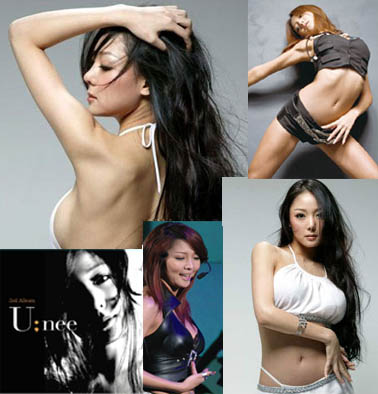
U-NEE IS GONE


U-Nee hanged herself a week ago.
Fans of the albums she released in 2003 and 2005 were expecting something hot from their Korean pop idol in 2007. She had mirrored Christina Aguilera and other dance-pop divas who stoked libidos while studio musicians scratched up beats.
Like Aguilera, who was smart enough to drop the "skank" act before it killed her, U-Nee was having second thoughts about the way "sex goddess" simply becomes "ho" or "pop tart" or some other derogatory term.
After dutifully posing in leather and filling her tracks with the standard sexy tricks, U-Nee sent out a storm warning last year: "I'm going to come back with an improved self. I want to try shedding the sexy image I built for myself and bring a new image to my fans."
Her good intentions were destroyed by an incident that happened far away in Malaysia. That's where Altantuya Shaaribuu was murdered in October of 2006, her body blown to bits by explosives, identified only through DNA. Shaaribuu, a part-time model, was having an affair with Abdul Razak Baginda, a defense analyst. Did he kill her, did he assign a high-placed hitman, or was there a government conspiracy?
Adding insult to the fatal injury, sexy pictures of U-Nee were circulated as being secret poses of the late Altantuya. When the Malaysian woman's father declared, "That's not her...don't spoil her name," the backlash against U-Nee was like a tsunami.
Anti-U-Nee websites appeared and she was swamped with hate mail. U-Nee was already suffering from depression from her low image, the pressures of fame, and her workload in preparing her third album.
She left no note. Probably the day she died her computer was flooded with headers of hate and derision over her sexy pictures "defaming" the memory of a woman she never even knew. The trial of Altantuya's alleged murderer is scheduled to take place in 2008.
The singer who was born Heo Yoon May 3, 1981, died as U-nee, January 21, 2007.
Now you know the basics of her story.


You'd like to hear her sing?
U-Nee had a unique name but was pretty similar to every sexy female from Christina Aguilera to Mylene Farmer to Madonna, mixing techno, rap and pop, adding bonus tracks re-mixing with thumps and sound effects for the disco/dance crowd.
Her first album, "Code" has a song called "Oh Punch" that owes a bit to Britney Spears' "Hit Me Baby One More Time," while the song "Play," samples American Black phrases and "Go" is spiced by male rappers shouting "When I say Hey, You say Ho." Or something like that. On her second album, "I Want You" is a chaotic combo of rap grunts from men and upbeat sass from U-Nee. "One" opens like everyone's American Idol ballad and overflows with power pop anguish. She often imitated the phrasings of young black and Latina performers, using deliberately flat-voiced male rappers for ghetto cred.
The Illfolks choice is "Don't Cry Again," which flirts with disco, has a traditional Asian minor key melody, uses a bit of synth and a dash of rap-scratch and halfway through switches from Korean to English.
Now that's covering a lot of bases! It might reflect the fractured nature of K-Pop, which keeps turning away from traditional Asian tonalities to mimic all the latest trends coming out of America. At least "Don't Cry Again" has some of the tantalizing dabbling into sharps and flats that you expect from Eastern melody, and U-Nee doesn't try to get too ghetto in her phrasings. If you need to hear U-Nee...
DON'T CRY AGAIN is one of U-Nee's most universally accessible songs

Thursday, November 09, 2006

Eun-Ju Lee (Corrs song) FALLEN STAR

Like a falling star, Eun-Ju Lee was a bright and beautiful presence for a short time, and when thousands began to point to her, that's when the descent began.
This pretty South Korean actress seemed to deal with each new challenge in her career, rising from teen comedy roles to the more difficult parts of a blind woman, a woman dying of cancer, and a reporter carrying a deadly fetus. In many films her screen character suffered and died, and it seemed tough for this increasingly depressed and weary young woman to go home at night and shake off the day's shoot.
Adding to her pressures was family debt, an irony considering she was now one of her country's biggest stars. She appeared in "Tae Guk Gi," which was to South Korea what "Gone With the Wind" is to the U.S.A., starred in "Phoenix" (aka "Firebird") a huge TV soap opera (now on 9 DVD discs) and, near exhaustion, took on yet another bizarre and harrowing role. In "The Scarlet Letter" she played a bisexual nightclub singer in a script containing nudity, violence and gore. Aside from grotesque scenes in which she was blood-spattered and screaming, she also had to be convincing in the scene in which she performs a song.
She chose to sing in English, and performed the eerie Corrs song "Only When I Sleep." It was her only recording, and her last role. Not long after the film was made, and only weeks after graduating college, Eun-Ju Lee slit her wrists and hanged herself, leaving an apologetic note to her mother.
Two notes: in South Korea last names are given first (there, she's Lee Eun-Ju) and since phonetic English translation varies, her name is often spelled Eun-Joo. An actress with a similar name co-stars in "Take Care of my Cat."
Here's a worthy version of "Only When I Sleep,"even if she had some difficulty pronouncing certain words. Perhaps the fleeting photos on this page will lead you to buy or rent one of her films. She was talented, beautiful, and for as long as it was possible for her, determined and brave.
Eun-Ju Lee covers ONLY WHEN I SLEEP