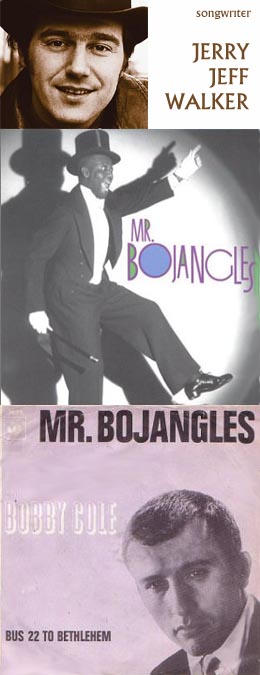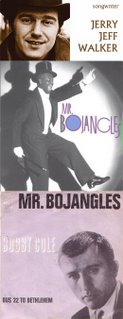
Nearly 40 years ago, Jerry Jeff Walker began strumming up a tune inspired by Bill "Bojangles" Robinson, the dancer/vaudevillian. A folkie at the time with country leanings, he played the song pretty straight. In the audience one night was Bobby Cole, a singer now better known as the arranger/conductor for Judy Garland.
Lightning struck. Bobby probably had the same glow George Martin got on hearing a demo of "Being for the Benefit of Mr. Kite." What possibilities! With production ideas brimming in his mind, Bobby called in all favors, got recording studio time, and after a brief release on his own Concentric label, finally got Columbia/Date to put out the single. At the same time, Walker recorded his folk-strumming version.Bobby transformed the simple, unadorned folk ballad by adding the flavor of vaudeville and traveling shows; he used a calliope effect for the introduction, and updating lounge for the psych 60's found a woman who could play a weird brand of electric violin that wistfully tinged the tune into sunset colors. Ultimately, he added his unique vocal. The song sounds like it's from someone as weary and worn as Mr. Bojangles himself.
When Bobby's song hit the airwaves, try to imagine how stunned Top 40 audiences were; the strange arrangement, the unusual violin in there, and the wistfully haggard vocal so different from anyone else. In its way, the single was as daring as "Sgt. Pepper."
As the song climbed the charts, ATCO offered competition via Jerry's version, a simple, honest strum. Where Columbia had influence, Bobby's was the radio hit. Where Atco reigned, stations favored Jerry's version. Both stalled at the edge of the Top 40 in the summer of 1968.
Together, Cole and Walker blazed a trail followed by dozens and dozens of cover versions. People chose to follow Walker (Dylan, Nitty Gritty Dirt Band, etc.) or they emulated Bobby (Sammy Davis, George Burns, Robbie Williams).
Sadly neither man would have another hit single. At least, Walker fans got a lot more albums and Jerry Jeff is still out there.
How I met my friend Bobby Cole is a kind of "Bojangles" story. Some twenty years after the song came out, I met him in a club, not down and out, but playing the standards. Like the man in the song who asked Bojangles to dance, I asked Bobby if he'd play a song for me; "Bus 22 to Bethlehem," the flip side to "Mr. Bojangles." Bobby was surprised to hear anyone mention that song. "Stick around," Bobby said in that gruff voice, "I wanna talk to you." He and his trio had taken a break between sets and he had to get back.
I'll just say that he turned out to be one of the most unique friends I ever had. I miss him.
"One Hit Wonder" is a cruel term, but here, it applies to a strange little moment in time when lounge and jazz sensibilities (note the backbeat drums and the late arrival of the clarinet toward the end) melded with progressive rock (the influence of "Mr. Kite" seems evident) and as produced, arranged and sung by Bobby Cole, produced a gem.
The nine other versions you get include Jerry Jeff Walker's mono single, the Nitty Gritty gang, John Denver, Sammy Davis Jr., Robbie Williams, Luba Mason, Nina Simone, etc. etc. Via R-Share of course:
MR. BOJANGLES
DANCE